
The wealth management industry understandably devotes considerable attention to investments. Asset allocation, manager selection, portfolio construction and risk management occupy the centre of most discussions because they are measurable and directly influence financial returns. Yet when viewed through the lens of multi-generational wealth, these topics, while important, are not the primary determinants of long-term success.
Families capable of creating extraordinary fortunes frequently struggle to preserve them beyond the second or third generation, despite having access to increasingly sophisticated financial advice and institutional-quality investment opportunities.
A small number of families, endowments and foundations have demonstrated that is is possible to preserve and grow capital over centuries despite geopolitical and structural changes, wars, financial crises, political upheavals and technological revolutions.
The difference rarely lies in consistently superior investment returns. Rather, it lies in the quality of the institution responsible for making investment decisions.
We advance a simple but fundamental proposition: the true asset of a family office is not its portfolio, but its institutional capability. Portfolios are visible expressions of capital allocation. Institutions are the mechanisms that determine whether sound capital allocation can continue long after the individuals who built the wealth are no longer present.
Viewed this way, the purpose of a family office extends beyond managing investments. Its role is to preserve decision quality, cultivate sound governance, educate future stewards and ensure that each generation inherits not merely financial assets but the capability to manage those assets wisely.
Investment performance remains essential. However, viewed over 100 years, institutional resilience is likely to contribute more to preserving wealth and survivability than any individual investment decision.
I. The Great Misunderstanding About Family Wealth
Most discussions about wealth begin with assets.
How should a portfolio be allocated? Which asset classes are likely to outperform over the coming decade? Should private equity occupy a larger proportion of the portfolio? How much exposure should be allocated to artificial intelligence, infrastructure or private credit?
These are sensible questions. Indeed, they are questions that any responsible investment office should ask continuously.
Yet they are not the questions that determine whether a family remains wealthy a century from now.
That statement may appear surprising. After all, investment returns compound mathematically. Surely the family with consistently superior returns must eventually become the more successful one.
Mathematics, however, tells only part of the story.
Human institutions do not compound in the same manner as financial capital. They strengthen gradually through discipline, shared values and accumulated judgement, but they can deteriorate remarkably quickly when governance weakens or incentives become misaligned. Unlike portfolios, institutions cannot be diversified, hedged or easily rebuilt once they begin to fail.
This distinction becomes increasingly apparent when we examine the history of enduring wealth.
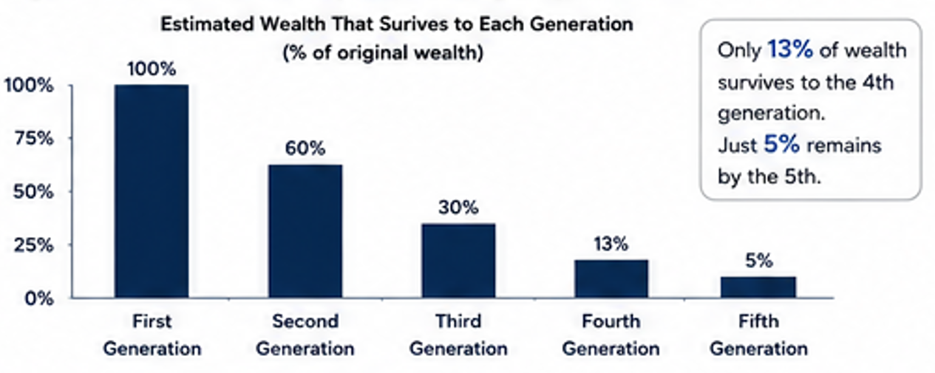
Source: Wealth and its Perpetuation Across Generations, Williams Group, 2018
Across cultures, remarkably similar observations have emerged. The English speak of “shirtsleeves to shirtsleeves in three generations.” In Chinese culture, a comparable proverb observes that wealth seldom survives beyond the third generation. Similar expressions exist throughout Europe and the Middle East. These sayings were not developed through academic research, yet they reflect centuries of collective observation.
The persistence of these proverbs raises an obvious question. Why should wealth exhibit such a predictable pattern of decline?
If financial capital alone determined long-term outcomes, one might reasonably expect the opposite. Each successive generation should benefit from greater resources, better education and more sophisticated professional advice. Instead, history often demonstrates a gradual erosion of both wealth and cohesion.
The explanation is unlikely to be found solely within investment markets. Instead, it is more often rooted in the gradual weakening of the institution responsible for managing the family’s capital.
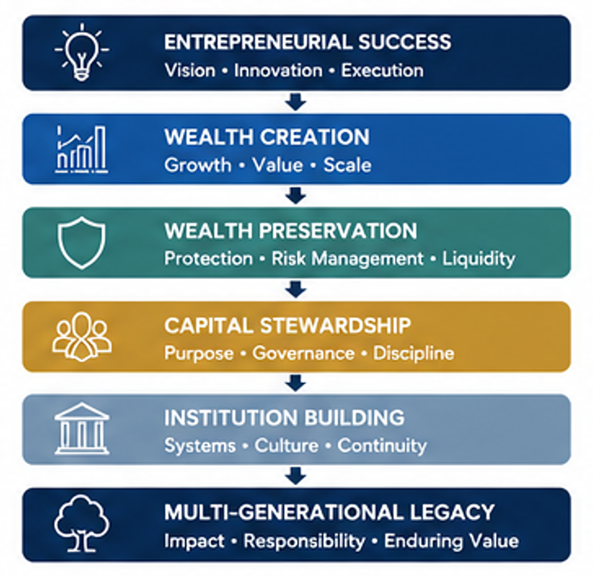
The Evolution of Wealth
Source: FT Capital Partners Capital Stewardship Framework
The progression illustrated above is deceptively simple. Many entrepreneurs devote decades to moving from the first stage to the second. Considerably fewer devote equal attention to the final stages. Yet those final stages are where multi-generational outcomes are ultimately determined, and where family values and principles can be preserved.
Financial capital can be accumulated relatively quickly. Institutional capital develops much more slowly.
II. Investment Returns Explain Less Than We Think
The investment industry understandably places considerable emphasis on performance. Asset managers are evaluated against benchmarks. Investment committees monitor quarterly returns. Consultants compare managers using increasingly sophisticated statistical measures. Such analysis is valuable because it introduces discipline and accountability.
However, an unintended consequence of this focus is the assumption that long-term wealth is principally a function of superior investment performance.
Evidence suggests a more nuanced conclusion.
Imagine two families beginning with identical wealth, identical access to investment opportunities and comparable long-term returns.
The first family enjoys an average annual return of 8.2%. The second family achieves 7.8%.
Over several decades, this difference is meaningful. Over fifty years, the first family’s assets will be 120% of the second family.
Now introduce a second variable.
The first family has no formal governance framework. Investment decisions remain heavily dependent upon one individual. Successive generations receive limited financial education, and disagreements regarding capital allocation are resolved informally.
The second family establishes clear governance structures, separates ownership from management where appropriate, documents its investment philosophy, and begins preparing future generations long before succession becomes necessary.
Which family is more likely to remain prosperous after one hundred years?
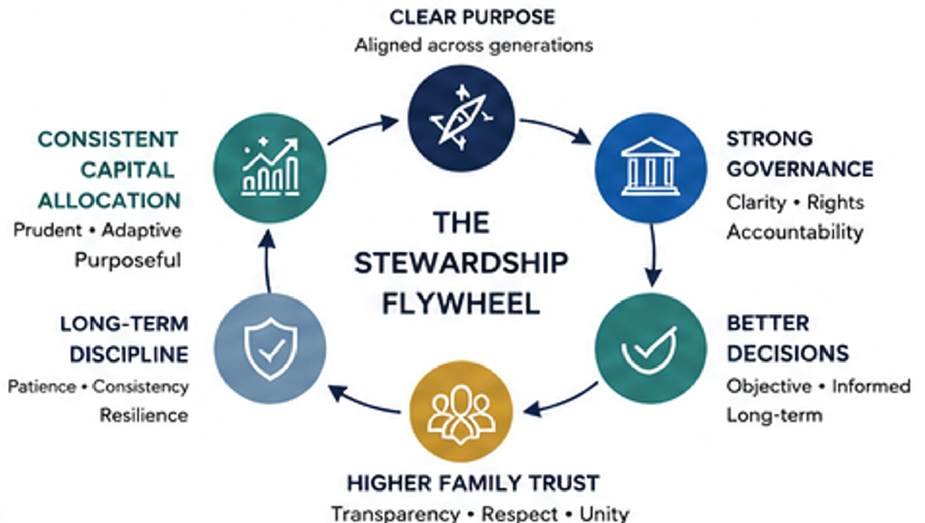
The Family Office Stewardship Flywheel
Source: FT Capital Partners Capital Stewardship Framework
Most experienced family office professionals would choose the second. Not because governance generates higher returns directly, but because governance improves the probability that future decisions remain rational during periods of uncertainty. This creates the flywheel that perpetuates the clear purpose of the family that should be aligned across generations.
Investment returns measure outcomes, while governance influences the quality of the process that produces those outcomes.
Over sufficiently long periods, process often proves more durable than prediction.
Paraphrasing an investment great, Howard Marks, superior investing depends less upon forecasting than upon consistently making better decisions than others. We would extend that principle further. Multi-generational wealth depends not merely upon individual decision quality, but upon creating an institution capable of producing thoughtful decisions regardless of who occupies leadership positions.
That objective is considerably more difficult. It requires families to think less like investors and more like builders of enduring institutions.
III. Institutions Compound More Reliably Than Portfolios
One of the most remarkable characteristics of financial markets is that they reward patience while simultaneously making patience extraordinarily difficult to practice. Every market cycle tempts investors to abandon carefully constructed strategies in pursuit of recent winners or to retreat entirely during periods of uncertainty. Behavioural finance has documented this tendency extensively, demonstrating that investors often destroy value not because they selected poor investments, but because they lacked the psychological strength, conviction or governance to remain committed when circumstances became uncomfortable.
Family offices are not immune to these pressures. In fact, they may be particularly vulnerable because investment decisions are rarely made in isolation. Every decision is embedded within a web of family relationships, differing objectives, generational perspectives and emotional considerations. Unlike pension funds or sovereign wealth funds, a family office is simultaneously an investment institution and a social institution. It must therefore manage not only financial risk but also interpersonal dynamics.
This distinction is often overlooked. Discussions surrounding portfolio construction tend to assume that investment decisions occur within a rational framework where objectives are clearly defined and consistently applied. Reality is considerably more complex.
Families evolve. New generations enter the decision-making process. Liquidity needs change. Risk tolerances diverge. Individuals who accumulated wealth through entrepreneurship often possess very different attitudes towards risk from those who inherit that wealth.
Consequently, the long-term success of a family office depends less upon constructing the theoretically optimal portfolio than upon constructing an institution capable of making consistently good decisions despite inevitable changes in people, markets and circumstances.
This is why we believe institutional capability compounds more reliably than financial capital.
Financial markets will inevitably experience periods of exceptional returns followed by periods of disappointment. Economic regimes will change. Inflation will rise and fall. Interest rates will move through cycles that appear unprecedented until history reminds us otherwise. No portfolio construction framework remains optimal indefinitely.
A family office stewardship cannot just focus on the investment process, rather the entire Stewardship Pyramid. An institution built upon this framework focuses also on disciplined governance, intellectual humility and continuous learning. That allows it to possess the ability to adapt without abandoning its principles. It does not require perfect foresight because its strength lies in the quality of its response rather than the accuracy of its predictions. These allow in-built systems to correct bad outcomes or misinformed decisions when – not if as they surely will occur – they arise.
This distinction mirrors the evolution of many enduring organisations. The world’s oldest universities, charitable foundations and family-controlled enterprises have survived centuries not because they correctly anticipated every political, technological or economic change. Rather, they developed cultures and governance structures capable of evolving while remaining faithful to their underlying purpose. They institutionalised judgement instead of relying exclusively upon individual brilliance.
Family offices should aspire to achieve the same outcome.
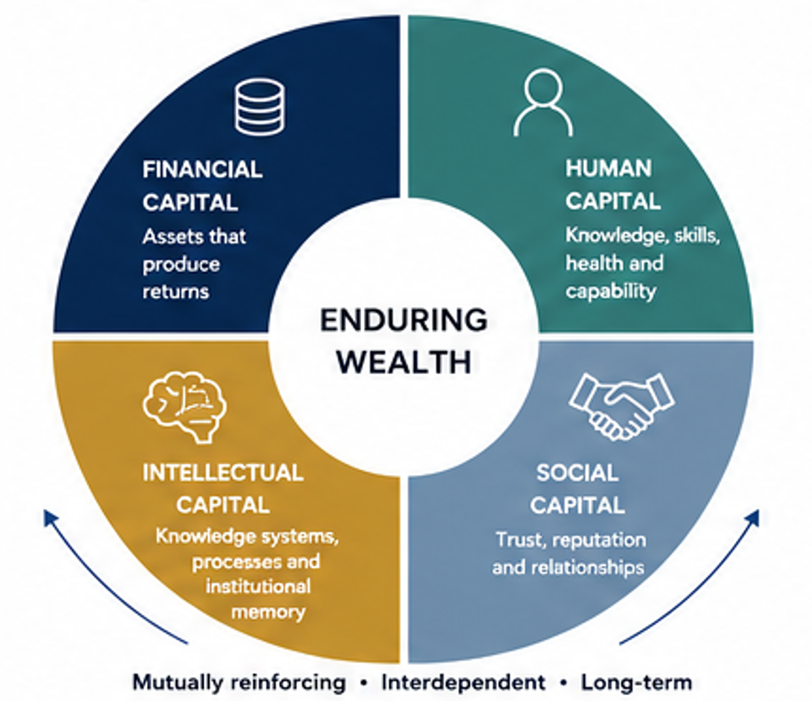
The Institutional Compounding Model
Source: FT Capital Partners Capital Stewardship Framework
The model above illustrates an important distinction. Financial capital compounds through mathematics. Institutional capital compounds through behaviour. The former is largely determined by markets. The latter is largely determined by deliberate choices made within the family itself. Because institutional capital influences every future investment decision, its impact extends well beyond any single market cycle.
IV. Beyond Financial Capital: The Four Capitals Framework
When families discuss wealth, the conversation almost invariably centres on financial assets. Net worth, portfolio returns and investment performance become the primary measures of success. While understandable, this perspective is incomplete. A family office responsible for preserving wealth over a century must recognise that financial capital is only one component of a much broader system.
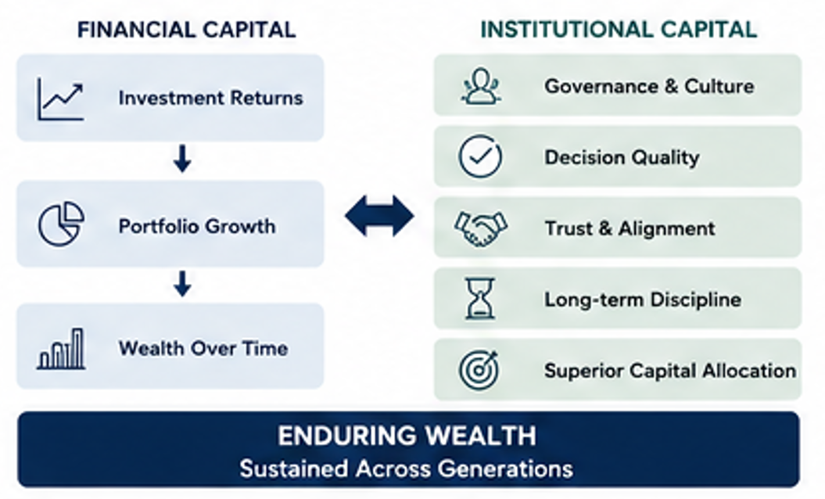
We propose that enduring family wealth rests upon four distinct forms of capital.
1. Financial Capital
Financial capital is the most visible and easiest to measure. It includes investment portfolios, operating businesses, real estate, private equity holdings and other financial assets. Without financial capital, the family office would not exist. However, financial capital is also the easiest form of wealth to transfer. Ownership can pass through trusts, wills and corporate structures with relative efficiency.
2. Human Capital
Human capital encompasses the knowledge, skills, health and capabilities of individual family members. Every generation inherits opportunities that depend not only upon financial resources but also upon its ability to use those resources responsibly. Families that neglect education while concentrating exclusively on wealth transfer frequently discover that financial capital alone cannot compensate for weak decision-making.
3. Intellectual Capital
Intellectual capital refers to the accumulated knowledge embedded within the family office itself. It includes the investment philosophy, governance framework, historical records of major decisions, lessons learned from previous market cycles and the processes through which investment opportunities are evaluated. Unlike financial capital, intellectual capital can disappear almost overnight if it remains concentrated in a small number of individuals rather than being systematically documented and transmitted.
4. Social Capital
Finally, there is social capital: the trust, reputation and relationships that enable families to operate effectively over generations. Reputation is difficult to value on a balance sheet, yet it often determines access to opportunities, partnerships and talent. Trust within the family is equally important. Governance structures become significantly more effective when they reinforce trust rather than compensate for its absence.
These four forms of capital are mutually reinforcing. Financial capital funds education. Human capital strengthens intellectual capital. Intellectual capital improves governance. Good governance protects financial capital. The system is circular rather than linear.
The Four Capitals Framework
Source: FT Capital Partners Capital Stewardship Framework
This framework has practical implications. Investment committees often spend hundreds of hours reviewing financial assets while devoting comparatively little time to strengthening the other three forms of capital. Yet over sufficiently long periods, deterioration in human, intellectual or social capital frequently precedes deterioration in financial outcomes. The balance sheet reflects the consequences of decisions; it rarely reveals the quality of the decision-making system itself.
V. Behavioural Erosion Precedes Financial Erosion
One of the more subtle observations emerging from long-term studies of family enterprises is that financial decline is rarely the first sign of institutional weakness. By the time wealth begins to diminish, the underlying causes have often been developing for many years.
Decision-making becomes increasingly centralised. Constructive disagreement is gradually replaced by deference. Investment discussions focus more on defending previous decisions than evaluating new information. Family members become recipients of wealth rather than participants in stewardship. None of these developments immediately affect portfolio returns. Markets may remain favourable for years, masking institutional deterioration beneath impressive performance figures.
This is precisely why governance should be viewed as a leading indicator rather than an administrative function. Strong governance does not guarantee superior investment outcomes in every period. It increases the probability that the institution will respond intelligently when conditions inevitably become more challenging.
Professional investors often emphasise downside risk because avoiding catastrophic losses contributes disproportionately to long-term compounding. We believe the same principle applies to family governance. Preventing behavioural deterioration is frequently more valuable than pursuing marginal improvements in annual investment returns. The institution that consistently avoids major governance failures may ultimately outperform one that occasionally achieves exceptional investment success but lacks organisational resilience.
The implication is both simple and demanding. Stewardship requires continuous investment in the institution itself. Governance cannot be designed once and forgotten. Education cannot be deferred until succession becomes imminent. Decision-making processes cannot remain dependent upon the founder indefinitely. Just as portfolios require periodic rebalancing, institutions require continual renewal.
VI. Designing a Family Office That Can Survive a Century
Every generation of wealth creators faces a similar temptation. Having successfully built capital through entrepreneurship or investment, they naturally assume that preserving wealth requires finding equally capable investment professionals. Consequently, considerable effort is devoted to identifying exceptional fund managers, constructing sophisticated portfolios and gaining access to exclusive investment opportunities.
These decisions are important. They are, however, only part of the equation.
A more fundamental question should be asked before any discussion about asset allocation begins: If the founder were no longer involved tomorrow, would the family office continue making decisions of the same quality twenty years from now?
This question is deliberately uncomfortable because it shifts attention away from portfolios and towards institutions. It asks whether the family’s accumulated judgement has become embedded within governance, culture and process, or whether it remains concentrated in one individual.
A family office that depends entirely upon its founder may appear highly successful today while simultaneously being structurally fragile.
The strongest institutions deliberately reduce dependence upon exceptional individuals. Commercial aviation provides a useful analogy. Passengers do not place their confidence in a single talented pilot; they trust a system of procedures, training, communication and continual review that allows different pilots to produce consistently safe outcomes. Excellence is institutionalised rather than personalised.
Family offices should aspire to the same principle.
An investment committee should not exist merely to approve transactions. It should preserve institutional memory. Governance documents should not satisfy legal requirements alone; they should explain why particular investment principles exist and under what circumstances they should evolve. The investment policy statement should become a living document that captures decades of accumulated experience rather than a static compliance manual reviewed only when necessary.
This perspective also changes the purpose of succession planning.
Succession is frequently treated as a legal event involving ownership transfer. In reality, succession is an educational process that may require decades. It begins long before leadership changes occur and extends well beyond the execution of estate planning documents. The objective is not to prepare heirs to inherit wealth; it is to prepare future stewards to exercise judgement under uncertainty.
Families often ask when the next generation should become involved in the family office.
A more useful question is how they should become involved.
Participation should not begin with investment authority. It should begin with observation. Younger family members should understand how decisions are debated, how disagreement is managed and why attractive opportunities are sometimes rejected. Exposure to disciplined reasoning is considerably more valuable than early exposure to capital.
Over time, responsibility should increase gradually. Individuals who demonstrate curiosity, humility and sound judgement should assume progressively greater roles within governance. Authority should follow demonstrated capability rather than age or inheritance alone. This principle is common within successful enterprises but surprisingly uncommon within family wealth structures.
The distinction matters because stewardship is ultimately behavioural rather than financial. Markets will always provide uncertainty. Institutions determine how uncertainty is interpreted and managed.
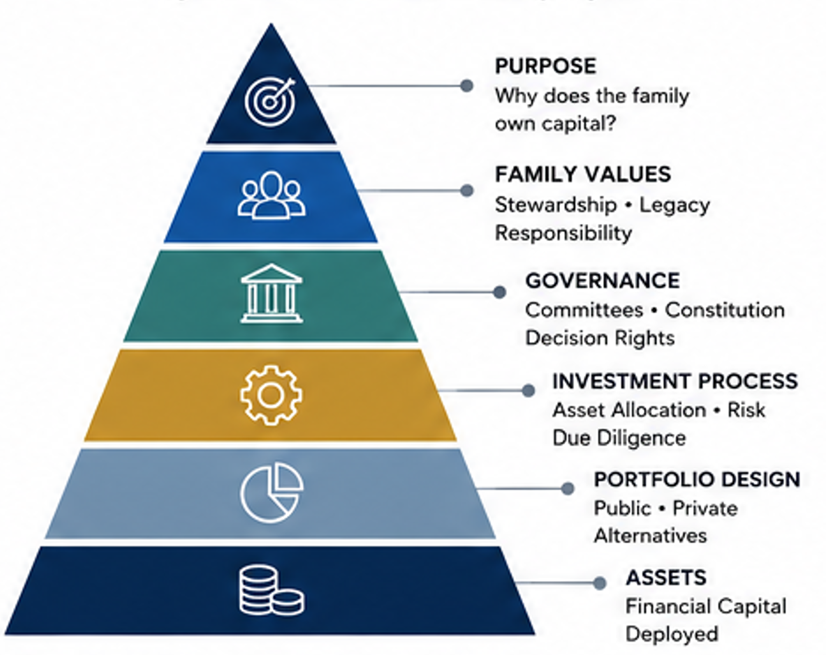
FTCP Stewardship Pyramid
Source: FT Capital Partners Capital Stewardship Framework
The Pyramid illustrates an idea that will recur throughout the FTCP Capital Stewardship Papers. Investment decisions occupy the foundation because they are the most visible and most frequently discussed. Yet their quality depends upon every level above them. A portfolio cannot consistently reflect long-term objectives if the investment process lacks discipline. The process itself cannot remain consistent without sound governance. Governance becomes fragile if the family lacks shared purpose and values.
Many investment discussions begin at the bottom of the pyramid.
Enduring institutions begin at the top.
VII. Measuring What Truly Matters
Investment organisations naturally measure financial outcomes because they are observable. Annual returns, volatility, Sharpe ratios and benchmark-relative performance are valuable indicators of portfolio management. Yet they provide limited insight into institutional health.
A family office seeking to preserve wealth across generations should broaden its definition of performance.
Alongside financial metrics, it should periodically evaluate governance quality. Are investment principles clearly documented? Are major decisions recorded together with the reasoning behind them? Does the next generation participate in investment discussions? Are disagreements resolved through established processes rather than personal influence? How frequently are governance arrangements reviewed? Can external advisers challenge prevailing assumptions without creating conflict?
These questions may appear qualitative, but they influence every quantitative outcome that follows.
Large corporations routinely evaluate organisational culture because they recognise that culture shapes behaviour. Family offices should demonstrate the same discipline. An institution capable of learning systematically from its successes and failures will often outperform one possessing superior technical investment expertise but weaker organisational foundations.
This philosophy also encourages greater humility.
No investment philosophy remains permanently correct. Every generation confronts circumstances that previous generations could not have anticipated. Artificial intelligence, geopolitical fragmentation, climate transition and demographic change will shape investment opportunities in ways that are difficult to predict today. Rather than attempting to forecast every structural shift, the wiser objective is to build an institution capable of adapting thoughtfully while remaining anchored to enduring principles.
Resilience should therefore be viewed as a strategic asset.
It is not the ability to avoid uncertainty, but the ability to respond intelligently when uncertainty inevitably arrives.
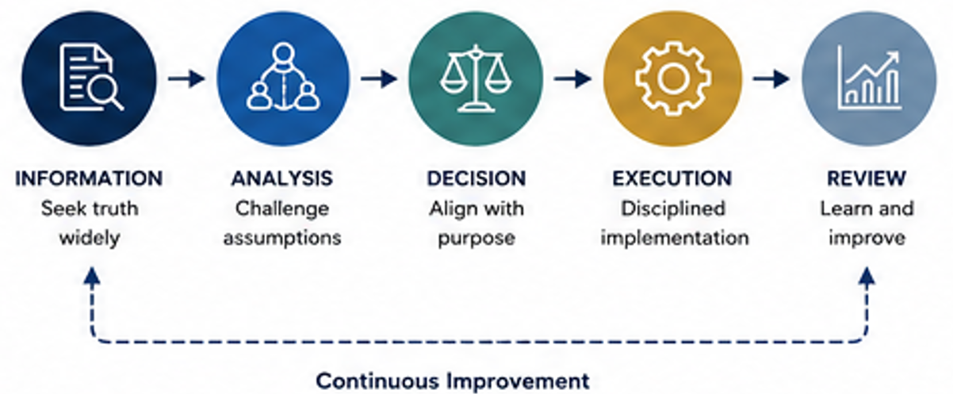
Decision Quality Loop
Source: FT Capital Partners Capital Stewardship Framework
Unlike financial compounding, this flywheel accelerates through repetition. Each cycle strengthens the institution’s capacity to make future decisions, creating a self-reinforcing process that extends beyond any individual leader.
VIII. Conclusion: Stewardship as the Ultimate Investment
Investment management will always remain central to a family office. Without disciplined capital allocation, financial wealth cannot be preserved. Yet to define the family office solely by its investment function is to misunderstand its broader purpose.
The most enduring family offices are not distinguished simply by superior investment returns. They are distinguished by their ability to preserve judgement, cultivate capable successors and institutionalise decision-making so effectively that wisdom survives long after the founders themselves, over generations.
Generational Stewardship Timeline
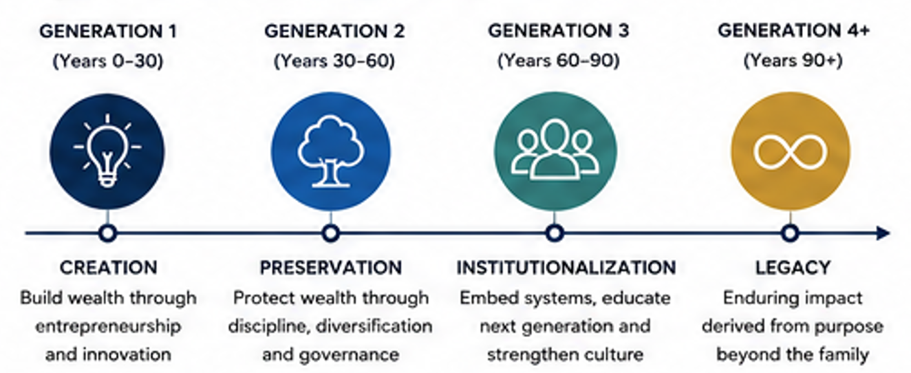
Source: FT Capital Partners Capital Stewardship Framework
Markets will continue to fluctuate. Technologies will evolve. Political regimes will change. New asset classes will emerge while others disappear. Every generation will believe that its challenges are unprecedented. Through all these changes, one principle is likely to remain constant: wealth is sustained not because institutions predict the future perfectly, but because they consistently make thoughtful decisions in the face of uncertainty.
Viewed from this perspective, the portfolio is not the family office’s greatest asset.
It is the product of its greatest asset. That asset is the institution itself.
A century from now, the individual investments held by today’s family offices will almost certainly be unrecognisable. The businesses, technologies and industries that dominate global markets will have changed repeatedly. If a family’s wealth has endured through those transformations, it will not be because every investment decision proved correct. It will be because each generation strengthened the institution responsible for making those decisions.
In the end, capital compounds through investment.
Legacy compounds through stewardship.
The greatest investment any family can make is therefore not in a security, a fund or a business, but in the institution that will continue exercising sound judgement long after today’s opportunities have passed.
Key Takeaways
The greatest competitive advantage available to a family office is not access to better investments. It is the freedom to think across generations while building an institution that becomes progressively wiser with time rather than increasingly dependent upon its founders.
A family’s greatest asset is not the portfolio it owns today. It is the decision-making capability that determines every portfolio it will own over the next hundred years.
As such, the defining objective of a family office should not be to outperform markets every year. It should be to ensure that each generation inherits a stronger institution than the one received from the previous generation.
#LegacyPlanning #NextGeneration #FamilyLeadership #FamilyOffice #AssetManagement #FTCPInsights