
Family offices rarely fail because markets are difficult. They fail because their operating models are fragile.
Over time, we see the same structural weaknesses appear repeatedly — often hidden during bull markets, but painfully exposed during periods of stress.
This is not surprising as there are many diverse areas to consider when setting up a family office as an institution to manage wealth over multi-generations, as seen below as a reference. Many families outsource it to banks and other professionals without truly understanding the rationale behind each structure to ensure long-term success, with problems compounding over time.
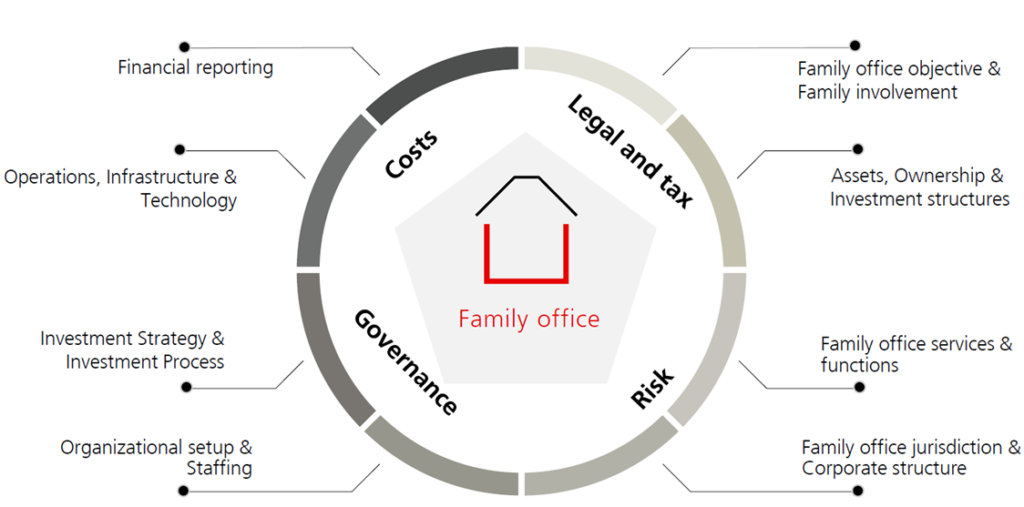
Source: Setting Up Your Family Office, UBS Family Advisory 2025
The Seven Most Common Mistakes
- Blurred decision rights. When it is unclear who decides what, accountability disappears and decision quality deteriorates.
- No formal risk framework. Without explicit risk budgets, insights on hidden risks and drawdown limits, portfolios are exposed to unintended risks.
- Over-concentration in legacy assets. Emotional attachment to founding businesses or historical winners often creates hidden tail risks without sufficient mitigations in place.
- Founder-centric decision-making. Family offices that depend on one individual do not scale and cannot survive succession.
- Weak reporting and oversight. If risks are not properly monitored, cannot be seen clearly, it cannot be managed.
- Ad-hoc decision-making. Reactive choices replace strategy, especially during volatile markets.
- Confusing wealth management with asset management. Serving family needs is not the same as running a resilient investment institution for multi-generational capital stewardship.
Why These Mistakes Persist
These issues typically stem from success. When markets are rising and wealth is growing, structural weaknesses usually remain hidden. Over time, with increase in complexity and growth in portfolios, problems compound and fragile governance structures are unable to keep up and may fail when it is most needed.
The result is a system that works until it suddenly does not and implode.
What a Robust Operating Model Looks Like
Institutional-grade family offices typically have:
- Clear separation between governance and execution
- Formal risk and asset allocation frameworks
- Defined processes for manager selection and review
- Scalable reporting and oversight systems to create governance alpha
- Decision-making processes and rules that hold under stress
The aim is not to build bureaucracy. It is about resilience and repeatability, and establishing sustainable systems that survive.
The Long-Term Perspective
Markets will always be volatile. Strategies will always evolve. Teams will change.
A strong operating model ensures that the family’s capital is not held hostage to any personalities, market cycles, or improvisation, but can remain robust and survive for multi-generations.
Key takeaway
The greatest risks in family offices are rarely in the portfolio. They are in the structures that govern it.
#FamilyOffice #Governance #Leadership #Stewardship #AssetManagement