
Many family offices have investment committees. Far fewer have investment committees that consistently improve investment outcomes.
The difference is not intelligence, credentials, or market experience. It is structure, mandate, and process.
In institutional investors such as endowments, sovereign funds, and pension plans, the investment committee’s primary role is not to stock pick nor debate market timing. It is to improve decision quality at the portfolio level and to ensure that strategy, risk, and execution remain aligned over time.
The Real Purpose of an Investment Committee
The investment committee executes the investment portion of the families’ holistic governance framework to meet the financial objectives. To be effective, a high-functioning investment committee focuses on three things:
- Strategy: Setting long-term asset allocation, risk budgets, and return objectives
- Investment governance: Defining decision rights, escalation paths, processes and accountability
- Discipline: Enforcing consistency across market cycles
The committee is not a substitute for management or external managers. It is the steward of the investment framework.
In family offices, a common failure mode is tactical overreach. Committees spend time debating short-term market moves, individual securities, or recent performance. This creates noise, blurs accountability, and often leads to inconsistent decisions driven by recency bias.
What Actually Creates “Governance Alpha”
The true value-add of an investment committee comes from:
- Preventing major strategic mistakes
- Reducing behavioural errors during stress
- Maintaining discipline and objectivity especially when markets are volatile
- Avoiding style drift and ad-hoc decision-making
- Ensuring risk budgeting and mitigation remains robust
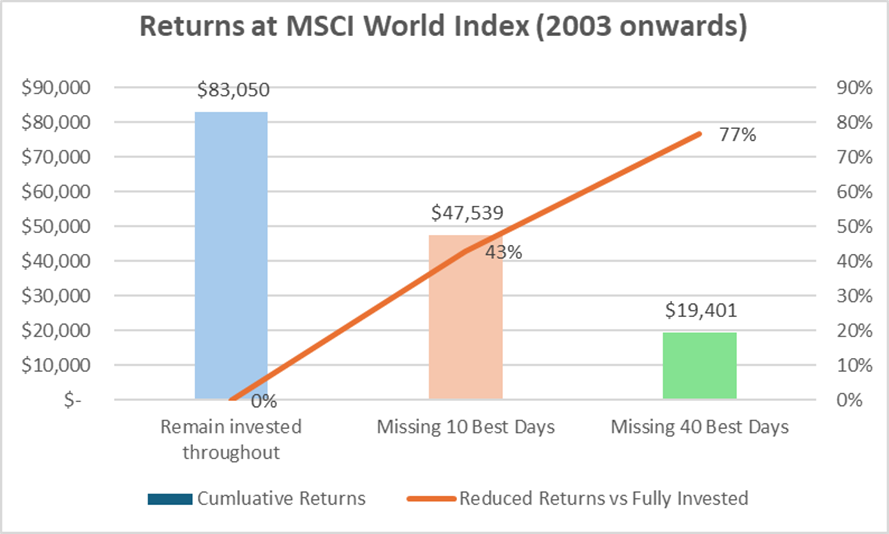
Source: Datastream – Daily returns of the MSCI World Index unhedged from 31 Oct 2003 to 2 Jan 2026
As was previously discussed in Why Volatility Targeting Outperforms Market Timing for Long-Term Investors, just missing only 10 best days out of 22 years will yield 43% less returns. Investment committees that help family offices maintain the course even if only during such times will already have contributed tremendously.
Governance alpha often matters more than security selection alpha.
Over long horizons, avoiding a small number of catastrophic decisions does more for compounding than making a few brilliant tactical calls.
Structure Matters More Than Personalities
Effective committees typically have:
- A clear charter and mandate
- Defined voting rights and quorum rules
- A structured agenda focused on strategy and risk
- Regular performance and risk reviews
- Independent perspectives to challenge consensus
Crucially, they separate oversight from execution. Management executes. The committee governs.
Structures and processes are essential to help ensure long-term sustainability and stewardship for multi-generational wealth that is not dependent on any single individual.
A Long-Term Advantage for Family Offices
For families with multi-generational objectives, the investment committee is not a forum for market opinions. It is an institutional anchor that ensures continuity, discipline, and consistency across time.
The goal is to be reliably right more often than wrong — and to avoid being disastrously wrong.
Key Takeaway
A great investment committee does not chase alpha. It creates the conditionsin which alpha can compound.
#FamilyOffice #Governance #Leadership #Stewardship #AssetManagement #InvestmentCommittee