
To compound capital across decades for multi-generational wealth demands robust governance and discipline. This will help safeguard against slowly eroding capital through drift, conflict, inflation and poor decision-making.
The most successful family offices in the world resemble endowments not because they follow similar asset allocation models, but because they adopt institutional governance frameworks: clear decision rights, disciplined processes, and long-term accountability.
Governance Is a System, Not a Document
Many families equate governance with constitutions, charters, or legal structures. In reality, governance is a living system that needs to be adaptable to evolving macro and geopolitical landscapes, and at the same time continually answer four fundamental questions:
- What processes to follow for which decisions to make?
- How are those decisions informed?
- How are risks mitigated and controlled?
- How is accountability enforced over time?
Without clear understanding, even the best investment strategies will eventually fail in execution.
The Three-Layer Governance Model
World-class family offices typically operate with three distinct, but connected layers:
1. Ownership Layer (Family / Principals)
This layer defines:
- Long-term objectives (preservation vs growth vs impact)
- Risk tolerance and drawdown requirements or constraints
- Time horizon and intergenerational priorities
Crucially, this layer sets family policy for the long-term, not portfolios.
2. Governance Layer (Boards & Committees)
This includes:
- Investment Committee
- Risk & Audit oversight
- Independent advisory board (if needed)
Their role is not to pick stocks, but to:
- Translate objectives into strategy
- Set risk budgets and allocation ranges
- Oversee implementation and performance
- Enforce process discipline
3. Execution Layer (Management & Advisors)
This is where:
- Portfolios are constructed
- Managers are selected
- Risk is monitored
- Reporting is produced
The best family offices strictly separate decision rights across these layers.
Why Most Family Offices Struggle with Governance
Common failure modes include:
- Founders retaining all decision authority indefinitely
- Investment committees that debate tactics instead of strategy
- No formal risk framework
- Blurred lines between family, board, and management
- No structured review or accountability process
These weaknesses rarely show up in bull markets. However, they become catastrophic and can amplify losses during crises and black swan events.
Governance as a Risk Management Tool
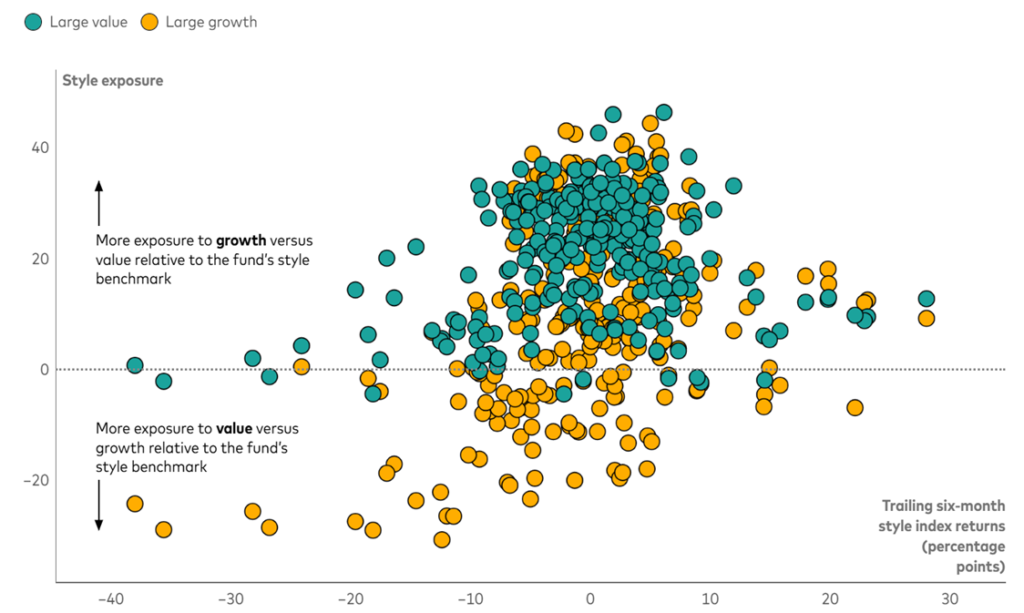
It is tempting to believe that professional managers on their own can adhere to their own strategies or style in the face of everchanging market sentiments. Research has shown that this is not necessarily the case. This drift, if unchecked, may naturally impact each portfolio’s original objectives and returns.
Large Value and Large Growth Active Funds Drift in Style Regardless of Relative Performance of Growth and Value
Source: Vanguard – Style-ish? Active style drift when styles are in vogue, 8 Oct 2025
Besides investment drift, good governance can act as the essential 1st line of defence to mitigate these other common mistakes:
- Concentrated positions that magnify risks
- Behavioural gaps or errors that impact long-term returns
- Forced selling during stress, exacerbating losses
- Strategy abandonment at the worst possible time
Endowments and sovereign funds survive market cycles not because they predict them, but because their governance prevents self-inflicted wounds.
The Role of Independent Voices
Top-tier family offices increasingly include:
- Independent investment committee members
- External risk oversight
- Periodic strategy reviews by third parties
- International benchmarks
This is to reduce blind spots and emotional bias and improve decision quality.
Governance should not be a Hindrance
In fast-paced and rapidly evolving macro environments, speed is of the essence.
Preventing governance from hindering investment speed requires transforming it from a “brake” into an “accelerator” through streamlining, clear delegation, and proactive risk management.
Good governance is not about limiting activity nor becoming a bureaucratic hurdle, but about enabling sustainable speed.
1. Streamline Decision-Making Processes
- Establish Clear Delegation of Authority (DoA). Define, document, and communicate clear decision rights. Empower investment teams to approve deals below a certain threshold without full board approval.
- Implement “Fast-Track” Approval Pathways. Create specific, streamlined protocols for urgent, high-conviction deals or smaller, routine investments, reducing meeting overhead.
- Use Agile Governance Models. Instead of lengthy, infrequent reviews, use regular, lightweight “checkpoints” to verify progress and risk management.
2. Adopt Risk-Based, Proactive Oversight
- Shift from “No” to “How”. View governance and risk management as a way to safely move fast, rather than a reason to stop. Identify potential pitfalls early to avoid last-minute, deal-killing surprises.
- Implement Exception Reporting. Rather than reviewing every detail, focus board attention on exceptions—investments that do not meet pre-agreed criteria—allowing for rapid decision-making.
- Use Pre-approved Guidelines. Set clear investment mandates, sector limitations, and risk tolerances. Investments falling within these guardrails can be approved quickly.
From Founder-Led to Institution-Led
One of the hardest transitions for any family office is moving from:
“The founder decides” to “The institution decides within a defined framework”.
This shift is essential for:
- Succession
- Scalability
- Continuity
- Professionalisation
Without it, multi-generational wealth stewardship becomes hostage to personalities rather than processes, making survivorship past the founder stage subject to chance.
What “Good” Governance Looks Like in Practice
- A written Investment Policy Statement that actually guides decisions
- Clear risk budgets and drawdown limits
- A structured asset allocation framework
- An Investment Committee with defined voting rights
- Streamlined decision-making processes
- Regular performance and risk reviews
- Pre-committed crisis playbooks
- Separation between oversight and execution
The Long-Term Advantage
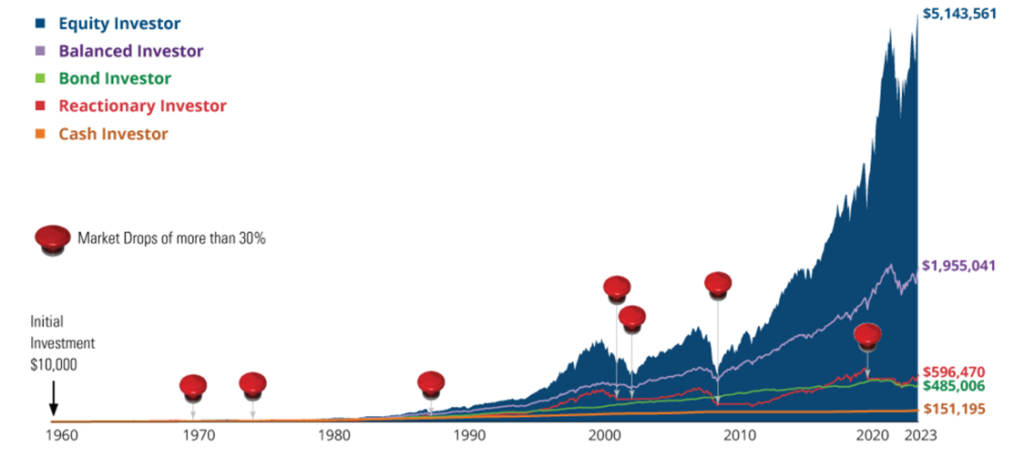
When systems and processes are not firmly in place, investors have more room to make errors, including overreacting and be unduly influenced by behaviour gaps, and swayed emotions or trends.
From 1960 to 2023, returns for reactionary investors are 88.4% less than investors who do not panic. This is a cautionary tale for family offices that are reactive and a stark reminder to establish robust governance.
Returns for Different Investors with $10,000 Invested in S&P 500 (1960 – 2023)
Source: Hartford Funds – Hardwired to React: Why Investors Make Mistakes that Could have been Avoided, 15 Apr 2024
Markets change. Strategies evolve. Teams turn over.
What remains is only strong governance structures that provide compounding advantage that can persist across generations.
For families serious about preserving and growing capital over decades, governance must not be viewed as overheads or a hindrance. It is crucial infrastructure that allows long-term wealth stewardship across generations.
Key Takeaway
The best family offices do not rely solely on decisions by brilliant individuals – these are prone to errors. They rely on robust systems that make good decisions repeatable — and bad decisions harder to make.
#FamilyOffice #Governance #Leadership #Stewardship #AssetManagement #WealthStewardship #InstitutionalInvesting #LongTermCapital