
The greatest threats to long-term wealth are not market crashes, recessions, or geopolitical shocks. They are human decisions made under pressure. Markets do recover and reach new height. If investors panic and sell under stress, that may cause permanent losses.
The Cycle of Investor Emotions
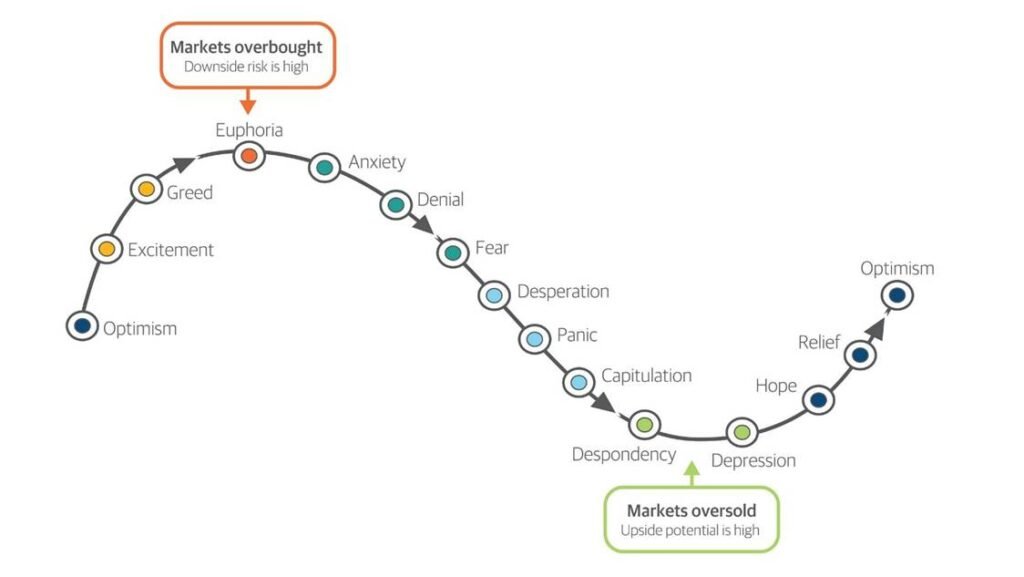
Source: Northwestern Mutual – Why Managing Your Emotions is Key to Smart Investing, 11 Sep 2023
Investors go through emotional roller coasters during market cycles. Influenced by feelings of euphoria, investors buy when markets are overbought and downside risk is high, and instead of buying when markets are oversold, they remain depressed and sell.
Behavioural finance shows that even highly sophisticated investors are vulnerable to systematic errors in judgement.
The Most Destructive Biases
Among the most damaging biases are:
- Loss aversion: Selling winners too early and holding losers too long
- Overconfidence: Taking excessive risk after periods of success
- Recency bias: Extrapolating recent trends into the future
- Confirmation bias: Seeking information that supports existing beliefs
- Action bias: Feeling compelled to “do something” during volatility
These biases do not cancel out. They compound, exacerbating errors resulting in mounting losses.
Why Families Are Especially Exposed
Family offices often combine:
- Emotional capital with financial capital
- Long histories with specific assets
- Strong personalities and legacy narratives
With emotional legacy, this makes purely rational decision-making even harder during stress.
How Institutions Protect Themselves
Instead of replying purely on willpower, institutional investors rely on processes:
- Pre-committed rebalancing rules
- Risk limits and escalation frameworks
- Independent oversight and Investment Committees
- Structured decision reviews
- Clear separation between strategy and execution
These systems are not designed to eliminate judgement. They are designed to protect judgement from predictable human error through biases.
The Long-Term Advantage
Over decades, avoiding behavioural mistakes often matters more than finding the perfect strategy.
Stress test results show that by being disciplined and not be influenced by one’s emotions and cognitive biases to sell in market trough yields positive outcomes.
Stress Test Results
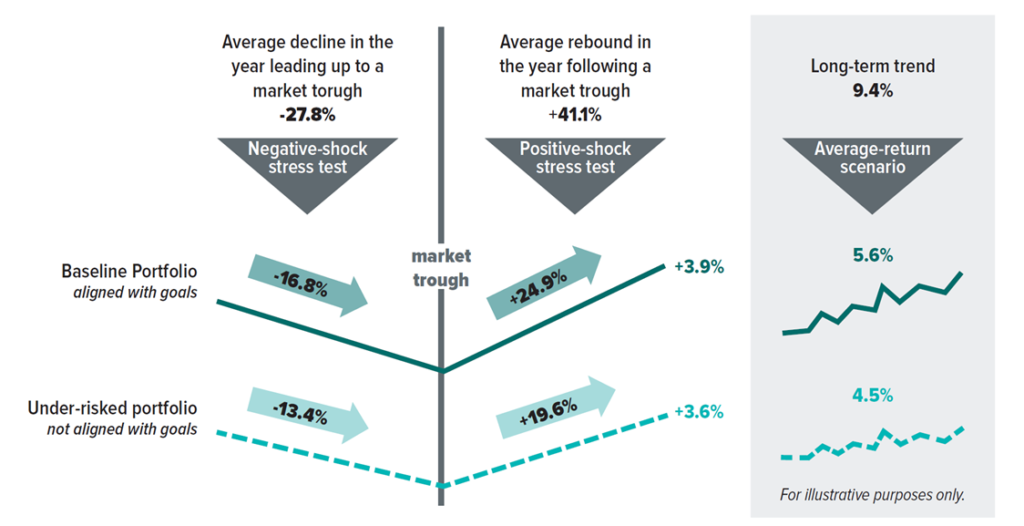
Source: SEI Investments Company – No Pain No Gain: Disciplined Investing Through Anxious Times, Mar 2020. Data from Bloomberg, SEI from 1957 to 2019.
Key Takeaway
The most important risk management tool is not a model. It is a decision-making system and process that anticipates human weakness, enabling family offices to be effective stewards of multi-generational wealth.
#BehavioralFinance #DecisionMaking #WealthPreservation #FamilyOffice #AssetManagement