

Yield is important for all investors, especially for family offices and endowments that have annual disbursements and cash requirements. As such, many such institutions need to construct portfolios that work towards a yield target.
However, target yield constraints impact efficient frontiers of multi-asset portfolios and hence, Sharpe ratios or risk-adjusted returns.
Efficient Frontiers for Unconstrained and Yield-Constrained Mult-Asset Portfolios
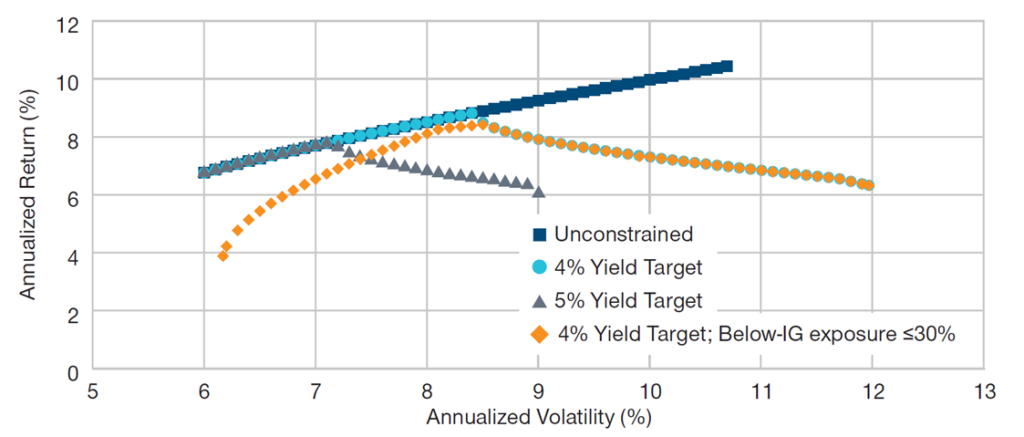
Source: The Impact of Yield Constraint on Portfolio Optimization, T Rowe Price, Sep 2018
This leads to the question: what are the enhanced risks for targeting or optimising yield, even if the risks are not easily observed?
Where is the Yield Coming from?
A portfolio generating 6% income may appear attractive on the surface, but where is that yield actually coming from?
In many cases, elevated yield may not be the result of strong underlying cash flows—but of embedded risks that are not immediately visible.
These risks often take the form of:
- Structural or explicit leverage
- Extended duration exposure
- Credit risk concentrated in weaker borrowers
- Equity-like downside packaged as “income strategies”
- Illiquidity combined with artificially smoothed returns
These risks are usually well camouflaged and not easily observed. Investors may not clearly understand the inherent risks trade-offs involved, and the asymmetric risk profiles they entail. These strategies may offer steady income in normal market situations, but result in significant downside in stressed conditions.
This is where many portfolios encounter problems.
Years of consistent yield can be offset by a single period of capital impairment. For long-term investors, especially family offices that are stewards of generational wealth, this is a poor trade-off.
How Should Institutions Approach Yield
Institutional investors should approach yield differently. Rather than asking, “How do we maximise income?”, they need to go understand:
- What is the true source of this yield?
- What risks are being undercompensated?
- How does this strategy behave under liquidity stress or credit events?
Sustainable income typically comes from exposures where returns are aligned with fundamental economic activity, such as:
- Senior secured private credit
- Asset-backed lending
- Real assets with stable cash flows
- High-quality, conservatively structured income strategies
These sources may not always offer the highest headline yield—but they tend to offer greater resilience.
Key Takeaway
For family offices, the objective should not be to chase yield.
It should be to construct multi-asset portfolios with durable income streams that can withstand market stress without permanent capital loss.
The most important attribute of income is not how high it is – It is how reliable it remains when conditions deteriorate.
#IncomeInvesting #PrivateCredit #RiskManagement #FamilyOffice #FTCPInsights