
Climate change is frequently discussed through political, environmental or social lenses. Institutional investors increasingly view it through a different lens: risk management.
Regardless of individual views on climate policy, one reality is difficult to ignore. Climate-related developments have the potential to influence economic activity, regulation, infrastructure, insurance costs, supply chains and asset valuations over long periods of time.
For investors with horizons measured in decades rather than quarters, these considerations deserve attention.
Climate Risks
The challenge is that climate risk and its impact on investments is often misunderstood.
Some investors believe climate resilience requires avoiding entire industries. Others assume climate considerations are irrelevant to portfolio construction. Neither approach is particularly useful.
Institutional investors should instead identify and manage material risks by distinguishing between two broad categories:
- Physical Risks. The risks can that directly affect assets, businesses and economic activity.
- Extreme weather events
- Flooding
- Water scarcity
- Infrastructure vulnerability
- Transition Risks. The risks can that alter industry economics and competitive dynamics
- Regulatory changes
- Carbon pricing mechanisms
- Technological disruption
- Shifts in consumer preferences
For family offices, the practical question is not whether climate change will occur exactly as predicted. Rather, the question is whether portfolios are sufficiently resilient across a range of possible outcomes.
Families need to ask:
- Which assets face significant physical exposure?
- Which industries may be vulnerable to policy changes?
- Which businesses are well-positioned to adapt?
- Are these risks adequately reflected in valuations?
Euro zone government bond returns are likely to be better if the world meets Net Zero 2050
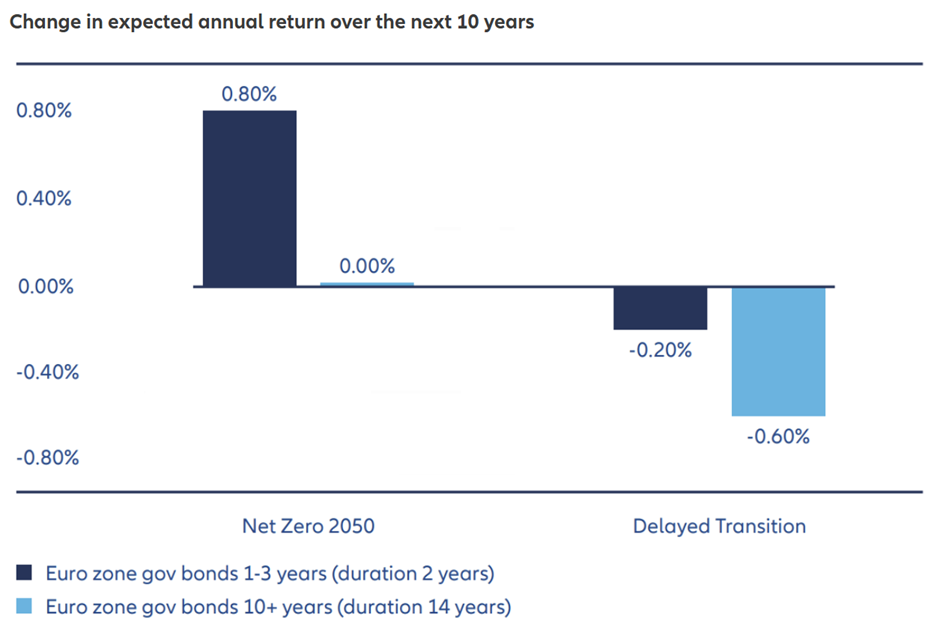
Source: Holdings data from Allianz Global Investors. Holdings data as of 29 September 2023. Input data from NGFS Scenarios Portal, MSCI. Input data as of 30 November 2023.
One example is to see the impact on the euro zone government bond returns if the Net Zero 2050 target is met. The delta in the expected return for just this one scenario alone can create a negative impact on the overall portfolio.
As such, leading institutional investors increasingly stress-test portfolios under multiple scenarios rather than relying on a single forecast to build a robust portfolio. This approach acknowledges uncertainty while improving preparedness.
Key Takeaway
Successful investing has always involved anticipating long-term structural changes before they become fully reflected in market prices.
Climate-related developments may prove to be one of the most significant structural forces influencing capital markets over the coming decades.
For investors responsible for preserving wealth across generations, understanding these dynamics to build multi-asset portfolios is becoming less optional and increasingly necessary.
#ClimateRisk #PortfolioConstruction #RiskManagement #Sustainability #FamilyOffice #FTCPInsights