
Indonesia’s financial regulatory framework continues to evolve with the enactment of Law No. 4 of 2026 amending the Financial Sector Development and Strengthening Law (P2SK Law) (Nurmansyah et al., 2026). While public discussion has largely centred on the expanded mandate of the Indonesia Deposit Insurance Corporation (Lembaga Penjamin Simpanan or “LPS”), the amendment carries broader implications than institutional reform alone. It represents another step in strengthening the legal infrastructure that supports investment, capital allocation, and financial market resilience.
Rather than merely expanding the mandate of LPS, Law No. 4 of 2026 forms part of a broader regulatory reform aimed at strengthening institutional governance, enhancing investor confidence, and improving the resilience of Indonesia’s financial sector (Republic of Indonesia, 2026). Mishkin and Serletis (2011:213) stated that financial vehicles, whether in the form of investment funds, insurance-linked products, structured financing arrangements, or other investment structures, ultimately depend on confidence in the financial system. Investors rarely assess investment opportunities solely on expected returns. Increasingly, they also evaluate how effectively a jurisdiction manages financial distress, protects stakeholders, and preserves market stability when financial institutions fail. In this respect, the amended P2SK Law deserves attention not because it introduces new investment products, but because it strengthens the legal foundations upon which those products operate.
Strengthening Indonesia’s Financial Safety Net
One of the amendment’s most significant developments is the expansion of LPS’s statutory resolution powers. Previously recognised primarily as Indonesia’s deposit insurance authority, LPS now assumes a substantially broader role in resolving both banks and insurance companies experiencing financial distress (Hertiawan et al., 20206). The amended framework authorises LPS to manage assets and liabilities, transfer insurance portfolios, provide financial assistance, exercise shareholder rights, transfer ownership interests, and restructure contractual relationships where necessary to facilitate orderly resolution. From a regulatory perspective, these reforms represent a transition from a predominantly liquidation-based approach towards a more proactive resolution framework. Rather than intervening only after institutional failure, LPS is now equipped with broader legal mechanisms intended to preserve financial stability while minimising systemic disruption. The introduction of statutory criteria governing insurance company resolution, including considerations of cost efficiency, market conditions, and investor availability, also demonstrates a more structured and commercially oriented approach to financial crisis management. For market participants, the amendment therefore extends beyond institutional reform. It strengthens the legal infrastructure supporting financial transactions by improving the predictability of resolution processes involving regulated financial institutions.
Why the Amendment Matters for Financial Vehicles
Although the amendment does not expressly regulate financial vehicles, several commonly used investment structures may nevertheless be affected by the strengthened resolution framework.
Investment Funds
Investment funds frequently maintain assets through custodian banks or engage financial institutions as counterparties. Under the previous framework, uncertainty regarding institutional resolution could create operational and legal risks affecting asset administration. The expanded powers granted to LPS provide a clearer legal basis for maintaining continuity during resolution, thereby reducing uncertainty for fund managers and institutional investors.
Insurance-Linked Investment Products
Insurance-linked products may also benefit from the revised framework. Previously, the absence of comprehensive statutory resolution powers created uncertainty regarding the treatment of policy portfolios during insurer distress. By expressly authorising portfolio transfers and broader restructuring measures, the amended P2SK Law enhances legal predictability for insurers, policyholders, and investors relying on insurance-based investment products.
Special Purpose Vehicles (SPVs)
Perhaps the most significant indirect impact concerns Special Purpose Vehicles (SPVs), particularly those established for structured finance, securitisation, or investment holding purposes. Although SPVs remain outside the direct regulatory scope of the amended P2SK Law, many rely upon banks or insurance companies as financing counterparties, custodians, trustees, or service providers. Under the previous framework, institutional failure could generate uncertainty regarding contractual continuity, asset administration, and enforcement of transaction documents. The expanded resolution powers now available to LPS, including authority to transfer assets and liabilities, restructure contractual relationships, and facilitate business continuity, may reduce some of these legal uncertainties. Consequently, sponsors, lenders, and investors establishing SPVs may wish to reassess transaction documentation, counterparty risk allocation, termination provisions, and financing arrangements in light of the revised resolution framework. Accordingly, sponsors and investors with existing SPV arrangements may wish to conduct a legal and operational review of their structures to determine whether amendments to transaction documents or risk allocation mechanisms are necessary in light of the revised resolution regime.
Before and After the Amendment
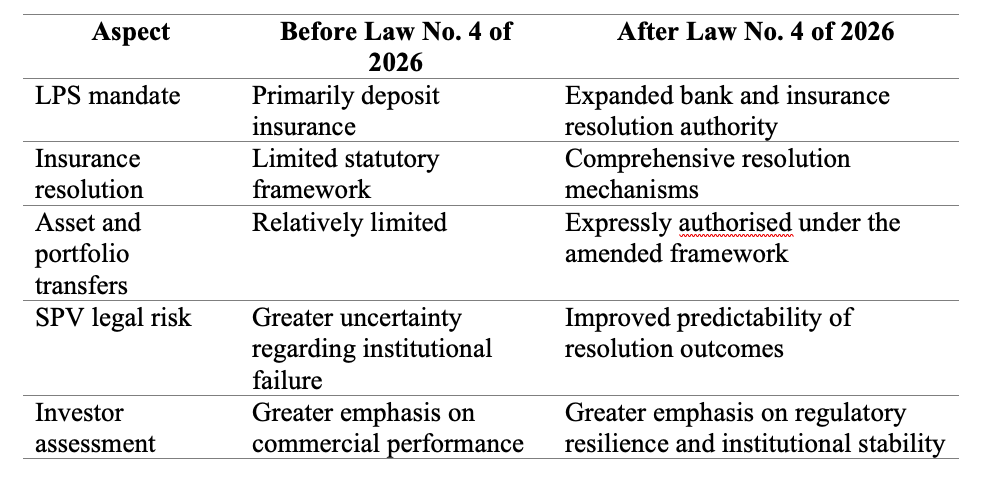
Collectively, these developments suggest that the amendment is likely to influence not only regulatory supervision but also the legal structuring of investment transactions. Financial vehicles should therefore be assessed within the context of Indonesia’s evolving resolution framework rather than solely from a commercial or tax perspective.
Looking Ahead
The amended P2SK Law should not be viewed as the conclusion of Indonesia’s financial sector reform. Much will depend upon implementing regulations and effective coordination among LPS, the Financial Services Authority (OJK), and Bank Indonesia. Questions concerning operational procedures, contractual implementation, and cross-sector supervision remain central to determining how effectively the new framework will operate in practice. Nevertheless, the broader implication of the amendment is clear. Financial vehicles no longer operate independently of financial sector regulation. As regulatory resilience increasingly becomes a component of investment decision-making, legal certainty surrounding institutional resolution will play a more prominent role in transaction structuring, asset protection, and capital allocation. For sponsors, institutional investors, and financial advisers, the amended P2SK Law is therefore not merely an institutional reform concerning LPS. Rather, it represents a regulatory development that should be considered when designing investment structures, allocating risk, and evaluating the long-term resilience of financial vehicles operating within Indonesia’s financial system.