
When succession planning is discussed within family offices, the conversation usually centres on ownership. Lawyers prepare wills and trusts. Tax advisers design efficient holding structures. Investment professionals review portfolio implications. These are all necessary components of preserving wealth, but they do not address the most fundamental question facing every enduring family enterprise.
Who will lead the institution once today’s leaders are no longer there?
This distinction is more important than it first appears. Ownership and leadership are not the same. Shares can be transferred through carefully drafted legal documents. Judgement cannot. A portfolio can be inherited overnight. The ability to allocate capital wisely, resolve disagreements, build consensus and make decisions under uncertainty often requires decades to develop.
History repeatedly demonstrates that family wealth rarely deteriorates because legal ownership fails to transfer. Rather, it weakens because leadership capability fails to transfer. Families spend considerable time designing estate plans but comparatively little time designing leadership succession. The result is that sophisticated ownership structures frequently coexist with fragile institutions.
This essay argues that family offices should think beyond succession planning in its traditional sense. The true objective is not simply ensuring that wealth changes hands efficiently, but ensuring that the institution responsible for managing that wealth becomes progressively stronger with every leadership transition.
Leadership succession is therefore not an event. It is a continuous institutional process.
I. The Hidden Leadership Risk
Every successful family office has two balance sheets.
The first is financial. It contains the assets that appear in investment reports: listed securities, private businesses, real estate, private equity funds, infrastructure investments, venture capital and cash. These assets are measured, valued and reviewed continuously. Their performance occupies the attention of investment committees and advisers because they are tangible and readily observable.
The second balance sheet is largely invisible.
It consists of accumulated judgement, institutional memory, trusted relationships, governance practices and the credibility of those responsible for making decisions. Unlike financial assets, these resources seldom appear in annual reports. They cannot be valued using conventional accounting methods, yet they frequently determine whether the financial balance sheet grows or declines over time.
Many family offices unknowingly allow the second balance sheet to become concentrated in one individual.
The founder understands why certain investment principles exist. The founder knows which external managers have earned trust through multiple market cycles. The founder remembers why previous acquisitions were rejected despite appearing attractive at the time. The founder has relationships developed over decades with bankers, advisers, business leaders and other families.
Much of this knowledge may unfortunately never be formally documented because it appears self-evident to the person who possesses it. Decisions are made intuitively, informed by years of experience that cannot easily be summarised in a policy manual. While this approach may function effectively during the founder’s leadership, it creates a hidden concentration risk.
Investment professionals devote considerable effort to avoiding concentration within portfolios. They diversify across industries, geographies and asset classes because they recognise that dependence upon a single source of return increases vulnerability.
Ironically, many family offices maintain highly diversified portfolios while allowing almost all institutional knowledge to remain concentrated in a single individual.
This is perhaps the largest unmanaged risk facing many successful family offices that many do not comprehend.
The Two Balance Sheets of a Family Office
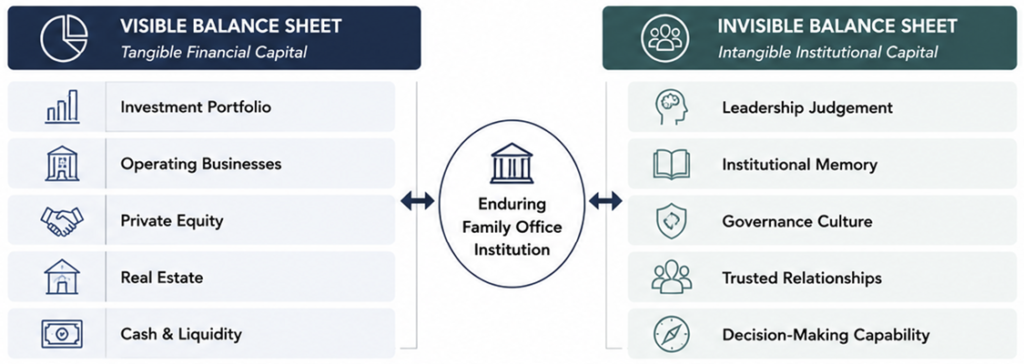
Source: FTCP Capital Stewardship Framework
The implication is profound. Financial capital can survive temporary market losses because diversified portfolios recover over time. Institutional capital is far more fragile. Once judgement, trust and leadership credibility disappear without effective succession, rebuilding them may require an entire generation.
For this reason, the Chief Executive of a family office should be viewed not merely as an executive responsible for managing investments, but as the principal custodian of institutional capability. The CEO’s most important responsibility is not selecting managers or negotiating transactions. It is ensuring that the organisation remains capable of making sound decisions and maintaining the family values long after the current leadership has stepped aside.
II. Succession Is Not a Date—It Is a Leadership Pipeline
Many families approach succession as though it were a milestone marked on a calendar. The founder reaches a particular age, retires from executive responsibilities and appoints a successor. Legal ownership changes, organisational charts are updated and the transition is considered complete.
Institutional succession rarely unfolds so neatly.
The most successful organisations—whether family-controlled enterprises, sovereign wealth funds or leading multinational corporations—do not treat succession as a single appointment. They build leadership pipelines years, sometimes decades, before a transition occurs. Potential successors are exposed to increasingly complex decisions, encouraged to challenge prevailing assumptions and given opportunities to demonstrate judgement under conditions of uncertainty.
Family offices should adopt the same philosophy.
Preparing the next Chief Executive begins long before a title changes hands. It starts with participation rather than authority. Emerging leaders should observe investment committee discussions, understand the rationale behind strategic asset allocation and appreciate why certain opportunities are declined despite their apparent attractiveness. They should learn that disciplined inaction is often as valuable as decisive action.
Only gradually should responsibility expand. Leadership capability is strengthened not through inheritance, but through experience accumulated over many market cycles. The objective is not to produce an identical copy of the founder. Every generation will confront different economic conditions and technological realities. Rather, the goal is to cultivate leaders who understand the institution’s purpose, possess sound judgement and can adapt principles to changing circumstances without abandoning them.
In this sense, succession resembles the development of an investment philosophy itself. Confidence emerges not from memorising answers, but by being guided by governance structures and learning how to ask better questions.
III. Building a Practical Succession Framework
A successful succession process should not begin when a founder announces retirement. By that stage, the family office may already be under pressure to make decisions too quickly. Instead, succession should be treated as a continuous leadership development process.
The first step is to identify the capabilities required of the next Chief Executive. In a family office, these capabilities extend far beyond investment expertise. The future leader must be able to balance financial objectives with family dynamics, preserve institutional culture while introducing necessary change, and make decisions under conditions of uncertainty.
The CEO Capability Pyramid
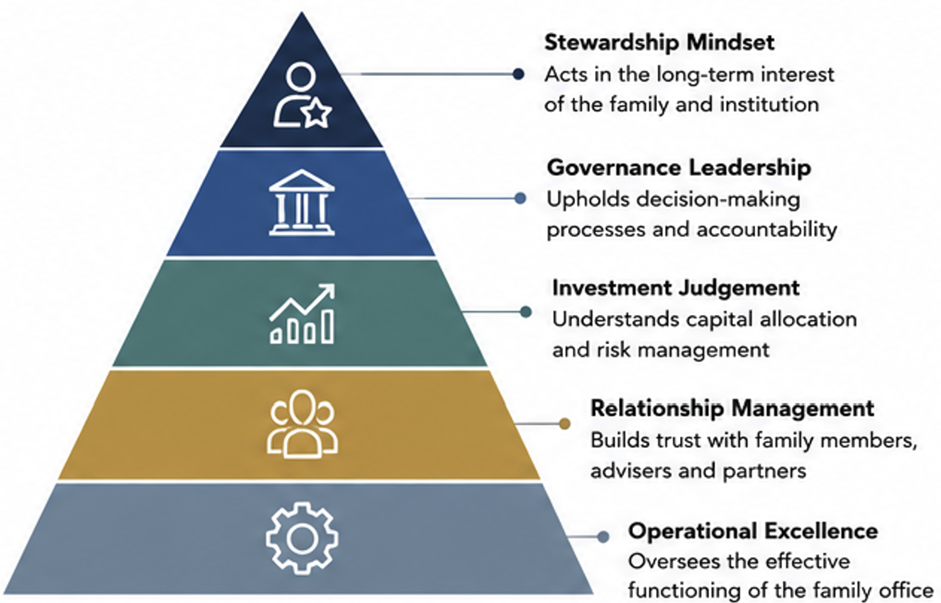
Source: FTCP Capital Stewardship Framework
This framework highlights an important point: investment judgement is only one component of effective leadership. A technically brilliant investor may still be an unsuitable CEO if they cannot build consensus, communicate clearly or preserve the trust of the family.
The second step is to create a leadership pipeline. Potential successors should be exposed to progressively greater responsibility over time. This might include attending investment committee meetings, leading smaller strategic initiatives, participating in governance discussions and eventually managing portions of the portfolio under supervision.
The goal is not to test whether a successor can replicate the founder’s decisions. It is to determine whether they can make sound decisions independently while remaining aligned with the family’s long-term purpose.
IV. The Leadership Succession Flywheel
Succession planning becomes most effective when it is embedded into the normal rhythm of the family office rather than treated as a separate project.
The Leadership Succession Flywheel
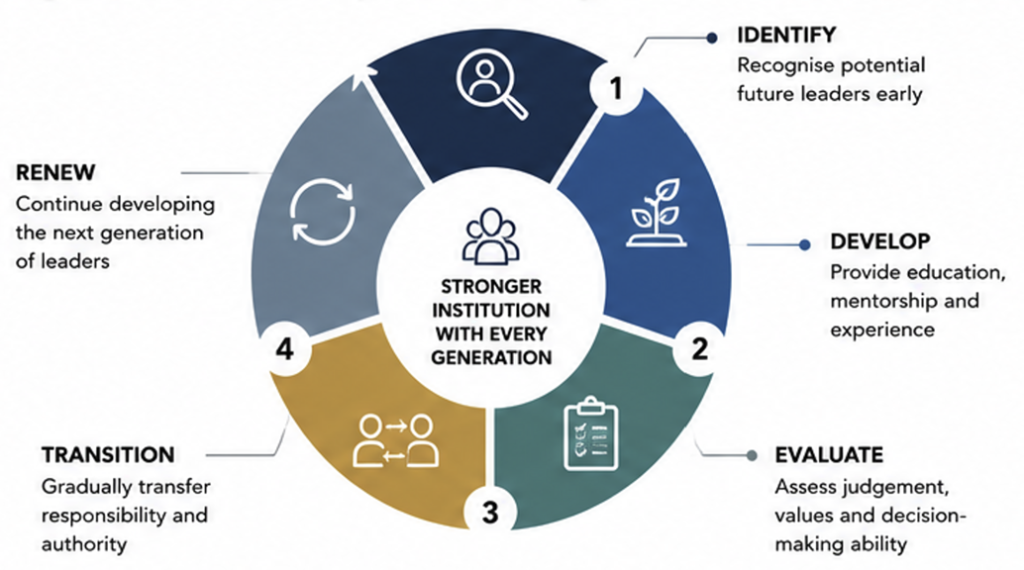
Source: FTCP Capital Stewardship Framework
This flywheel creates institutional continuity. Each generation of leaders is responsible not only for managing capital, but also for preparing the generation that will follow them.
Key Takeaways
Succession planning for a family-office CEO is fundamentally different from succession planning in a conventional corporation. The objective is not merely to replace an executive, but to preserve the institution’s accumulated judgement, culture and decision-making capability.
Families that approach succession as a legal or administrative exercise may achieve an orderly transfer of ownership while still leaving the institution vulnerable. Families that treat succession as a leadership development process are more likely to create a family office capable of enduring across generations.
The most successful succession plans do not produce a perfect replica of the founder. They produce a new leader who understands the family’s purpose, respects its principles and has the capability to guide the institution through challenges the founder could never have anticipated.
The true test of succession planning is not whether a new CEO is appointed successfully. It is whether the family office becomes stronger after the transition than it was before.
#LegacyPlanning #NextGeneration #FamilyLeadership #FamilyOffice #AssetManagement #FTCPInsights