
Family offices rarely fail because of a single catastrophic investment. More often, they fail because the institution responsible for making investment decisions gradually weakens. Governance becomes informal, accountability fades, communication deteriorates, and decisions that were once disciplined become increasingly reactive.
The tragedy is that governance failure is usually invisible while it is developing. During periods of strong market performance, weak processes can remain hidden beneath impressive returns. By the time financial consequences appear, the underlying institutional damage may already be extensive.
For families seeking to preserve wealth across generations, it is essential to build an institution where governance should not be viewed as administrative overhead. It is the invisible architecture that allows capital, values, and decision-making capability to endure beyond the founder’s lifetime.
The Silent Erosion Of Governance
Governance rarely collapses overnight. It erodes gradually through a series of small compromises that appear harmless in isolation.
A founder begins making decisions outside established processes because it is faster. Investment committee meetings become less rigorous because everyone trusts the same individuals. Family members avoid difficult conversations to preserve harmony. Roles and responsibilities remain ambiguous because clarifying them feels uncomfortable.
Each compromise may seem reasonable at the time. Collectively, however, they create an institution that becomes increasingly dependent on personalities rather than principles. This is further exacerbated over time without proper succession planning beyond the founder and initial key management.
The Governance Failure Cycle
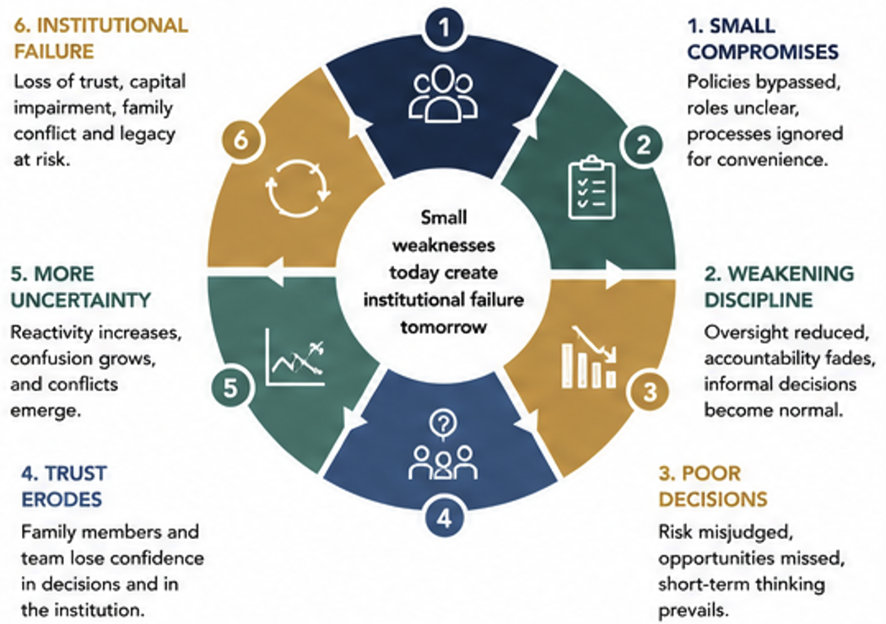
Source: FTCP Capital Stewardship Framework
This cycle is particularly dangerous because success can mask its early stages. Strong investment returns may create the illusion that governance is functioning well, when in reality the institution is becoming more fragile.
The Four Common Causes Of Governance Failure
1. Unclear roles and authority
When decision rights are ambiguous, accountability disappears. Family members, executives, and advisers may all assume that someone else is responsible for a critical decision. Effective governance requires absolute clarity regarding who has authority, who provides oversight, and who bears responsibility for outcomes.
2. Concentrated decision-making
Many successful family offices become overly dependent on a founder or a small group of trusted individuals. While this may produce efficient decisions in the short term, it creates a dangerous concentration of institutional knowledge and judgement. If those individuals are no longer available, the organisation may struggle to function effectively.
3. Weak accountability
Governance fails when poor decisions have no consequences and good decisions are not reinforced. Accountability does not mean assigning blame for every unfavourable outcome. It means ensuring that decisions are evaluated against agreed principles, documented reasoning, and long-term objectives.
4. Breakdown of communication and trust
Family offices are unique because they operate at the intersection of capital and relationships. When communication becomes defensive or trust deteriorates, even well-designed governance structures can fail. Open, respectful, and transparent dialogue is therefore a strategic asset, not merely a cultural preference.
The Governance Architecture of an Enduring Family Office
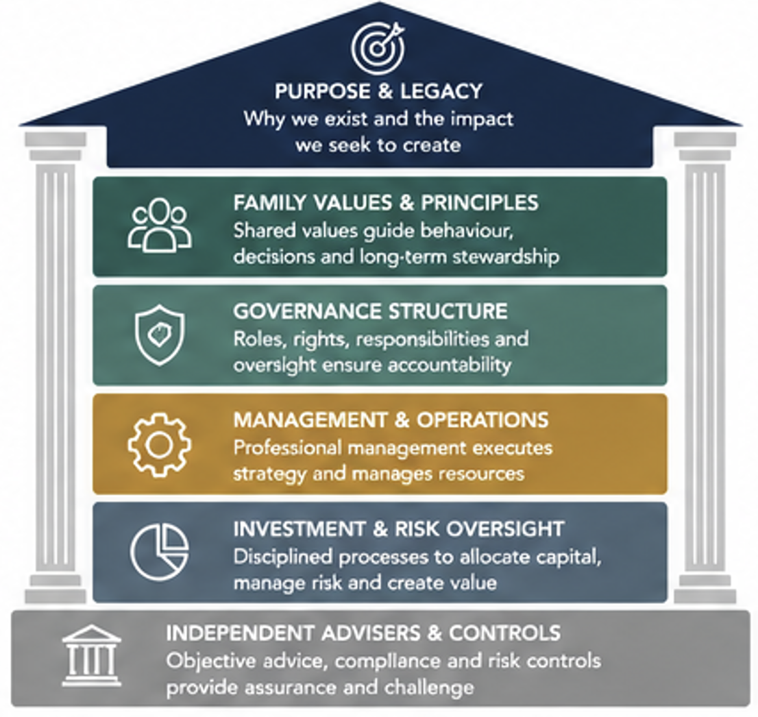
Source: FTCP Capital Stewardship Framework (Original)
What Family Offices Prioritise
Recent family office research consistently highlights governance, succession, and risk management as central concerns for wealthy families. While investment performance remains important, principals increasingly recognise that institutional resilience is essential for preserving wealth across generations.
Family Office Governance Priorities
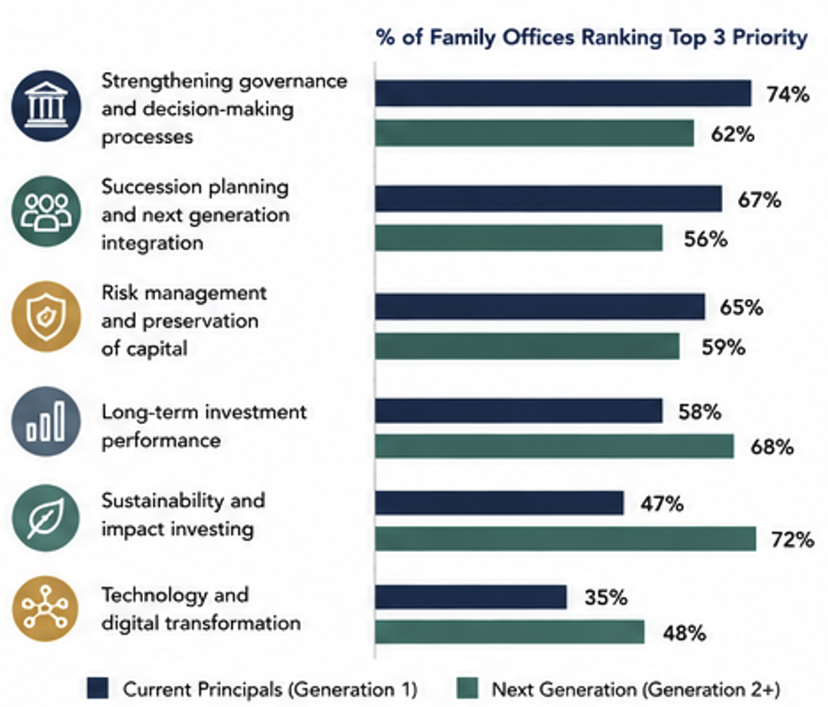
Source: What are your family office’s key objectives over the next five years?, UBS Global Family Office Report 2023
The chart reinforces a critical point: governance is not separate from investment success. It is one of the conditions that makes sustainable investment success possible.
Rebuilding Institutional Trust
When governance has weakened, rebuilding it requires more than drafting new policies. It requires restoring confidence in the institution itself.
The rebuilding process should begin with honesty. Families must be willing to acknowledge where governance has failed, whether through unclear authority, inadequate oversight, poor communication, or avoidance of difficult decisions.
From there, the institution can be rebuilt through a disciplined sequence:
- Clarify the family’s purpose and long-term objectives
- Define decision rights and governance responsibilities
- Establish transparent reporting and accountability mechanisms
- Encourage constructive disagreement within agreed processes
- Review governance regularly as the family and its assets evolve
The Governance Rebuilding Flywheel
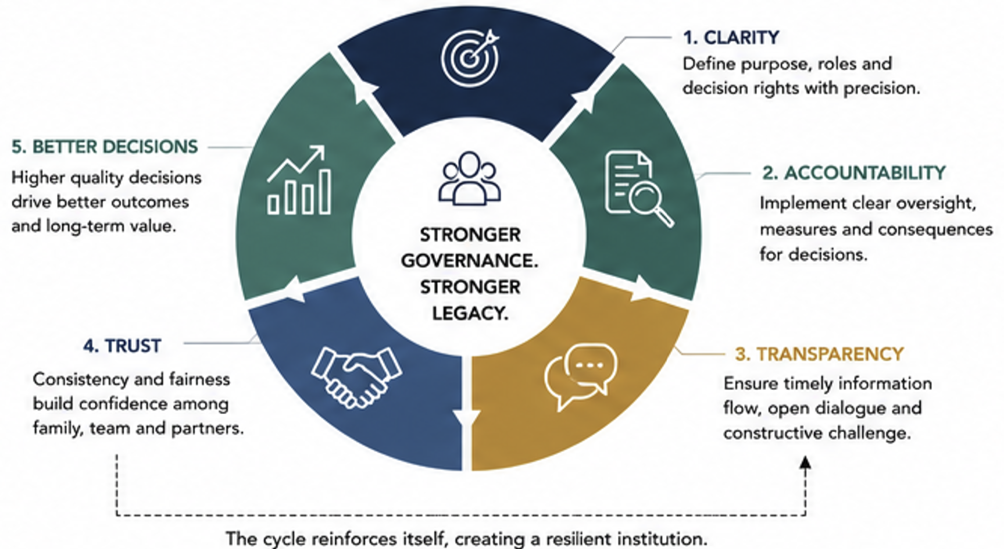
Source: FTCP Capital Stewardship Framework
As this flywheel strengthens, governance becomes self-reinforcing. Clearer processes improve decisions, better decisions build trust, and greater trust encourages long-term discipline.
Measuring Institutional Resilience
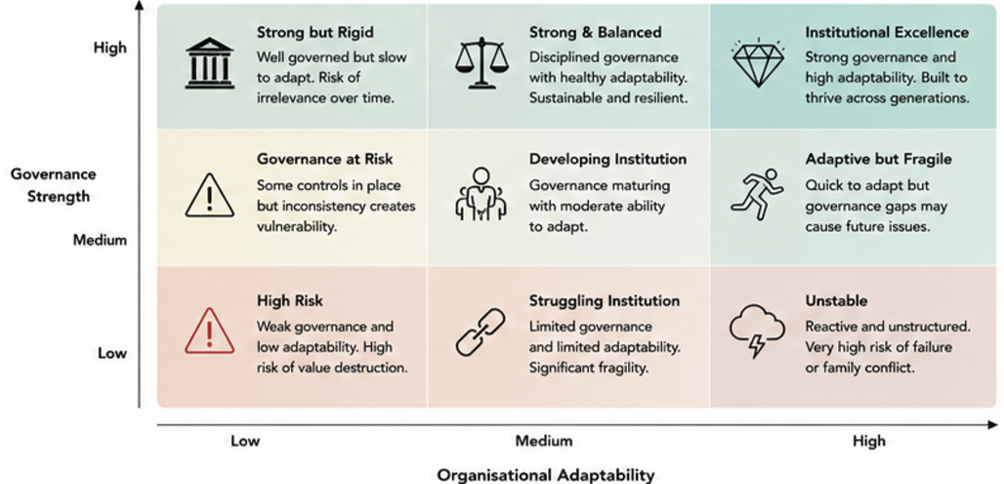
A family office should periodically assess not only its portfolio performance, but also its governance strength. One useful approach is to evaluate the institution across two dimensions: the quality of its governance framework and its ability to adapt to changing circumstances.
The Institutional Resilience Matrix
Source: FTCP Capital Stewardship Framework
The goal is to move toward the upper-right quadrant: strong governance combined with high adaptability. This is where family offices are most likely to preserve wealth, values, and decision-making capability across generations.
However, this is not a trivial process and needs to be conscientiously executed as a norm for family offices. It is to be embedded as part of the education process for the next generation, in order to develop proper stewards for multi-generational wealth.
Key Takeaways
Governance is often least appreciated when it is functioning well. It is quiet, procedural, and rarely celebrated during periods of prosperity. Yet when governance fails, its absence becomes painfully visible.
The most enduring family offices understand that governance is not bureaucracy. It is the mechanism through which stewardship becomes durable. It protects capital from impulsive decisions, preserves institutional memory, and creates the conditions for thoughtful leadership across generations.
In the end, rebuilding governance is not simply about repairing processes. It is about restoring confidence that the family office can continue making wise decisions long after today’s leaders are gone.
#LegacyPlanning #NextGeneration #FamilyLeadership #FamilyOffice #AssetManagement #FTCPInsights