
The greatest challenge facing a successful family office is not preserving capital for the next generation. It is preserving the judgement required to manage that capital responsibly.
Financial wealth can be transferred through trusts, wills and ownership structures with relative efficiency. Stewardship cannot. It must be cultivated gradually through education, participation, accountability and experience. Families that focus exclusively on wealth transfer often discover that financial assets are easier to pass on than the values, discipline and decision-making capability that created them.
For this reason, next-generation education should not be viewed as a peripheral family office activity. It should be regarded as a core investment in the institution’s future resilience. The objective is not to produce heirs who understand financial terminology; it is to develop stewards who understand the purpose of the family’s capital, the responsibilities attached to it and the consequences of poor judgement.
Stewardship is a developmental process
Many families introduce younger generations to wealth only when they reach adulthood or when succession becomes imminent. By then, expectations may already be entrenched and opportunities for gradual learning may have been lost.
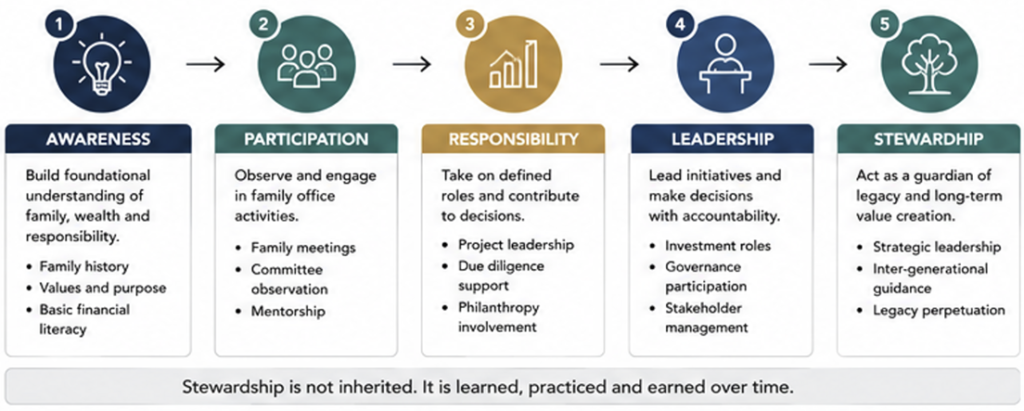
A more effective approach is to treat stewardship as a developmental journey that begins with awareness and progresses through increasing levels of participation and responsibility.
The Stewardship Development Pathway
Source: FTCP Capital Stewardship Framework
This pathway emphasises that stewardship is not inherited instantly. It is built through repeated exposure to decision-making, constructive feedback and increasing accountability over time.
The four dimensions of stewardship education
Traditional financial education often concentrates on investment concepts such as asset allocation, compounding and portfolio diversification. While these topics are important, they represent only one dimension of effective stewardship.
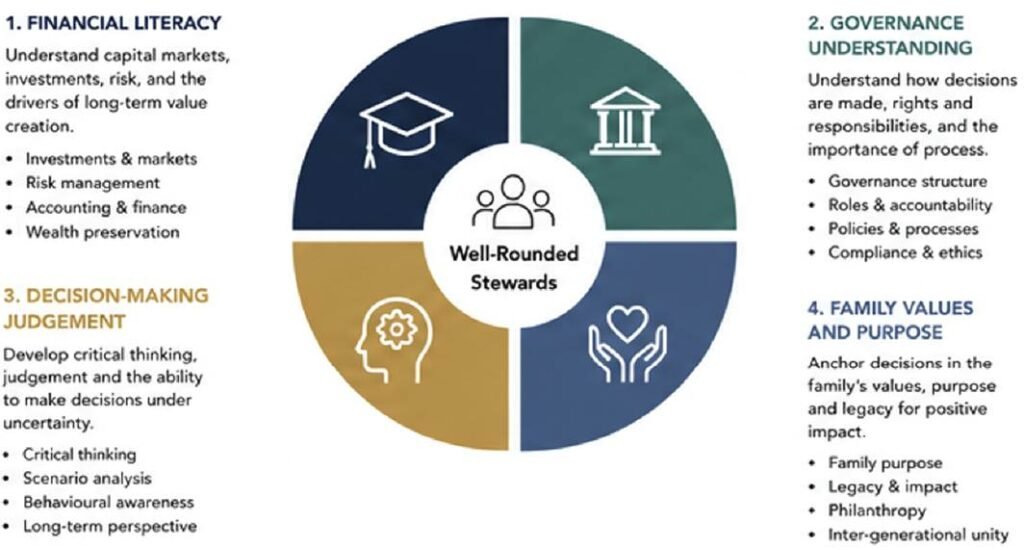
A family office seeking to prepare future leaders should educate the next generation across four interconnected areas.
The Four Dimensions Of Stewardship Education
Source: FTCP Capital Stewardship Framework
- Financial literacy provides the technical foundation for understanding capital allocation, risk and long-term investing.
- Governance understanding teaches how decisions are made, who has authority and why disciplined processes matter.
- Decision-making judgement develops the ability to evaluate uncertainty, challenge assumptions and avoid behavioural errors.
- Family values and purpose ensure that wealth is connected to a broader mission rather than becoming an end in itself.
The most successful family offices recognise that these dimensions are mutually reinforcing. Financial knowledge without values can encourage short-termism. Values without financial competence can lead to poor capital allocation. Stewardship requires both.
What Next-Generation Leaders Prioritise
Recent family office research suggests that younger generations often place increasing emphasis on purpose, sustainability and long-term impact alongside traditional wealth preservation objectives, while current principals priotise wealth preservation and growth.
Family Office Priorities by Generation
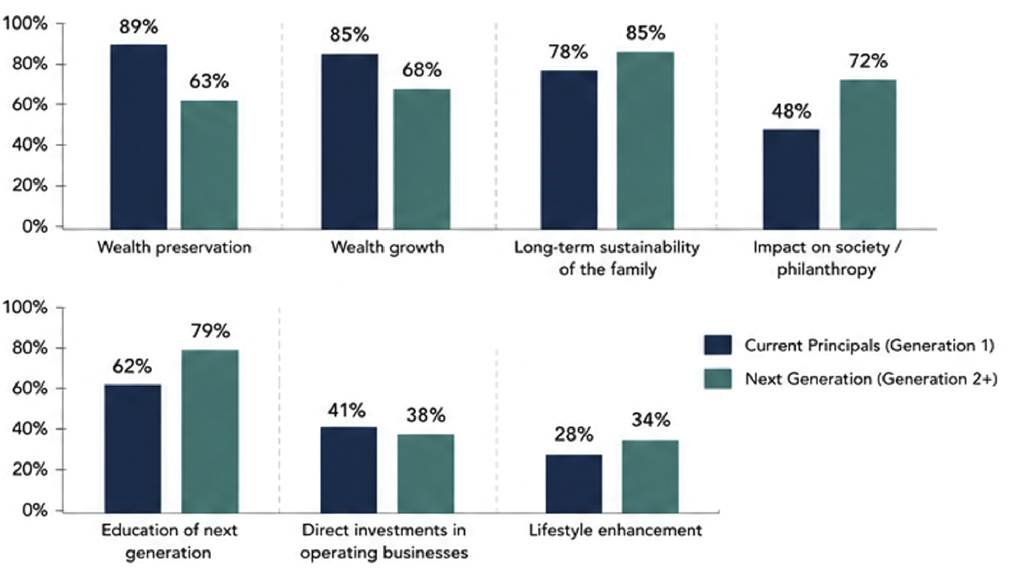
Source: “What are your family office’s key objectives over the next five years?”, UBS Global Family Office Report 2023
This does not mean that financial discipline becomes less important. Rather, it suggests that future stewards may evaluate investment decisions through a broader lens that includes purpose, legacy and societal impact. Family offices that ignore these perspectives risk creating a disconnect between generations.
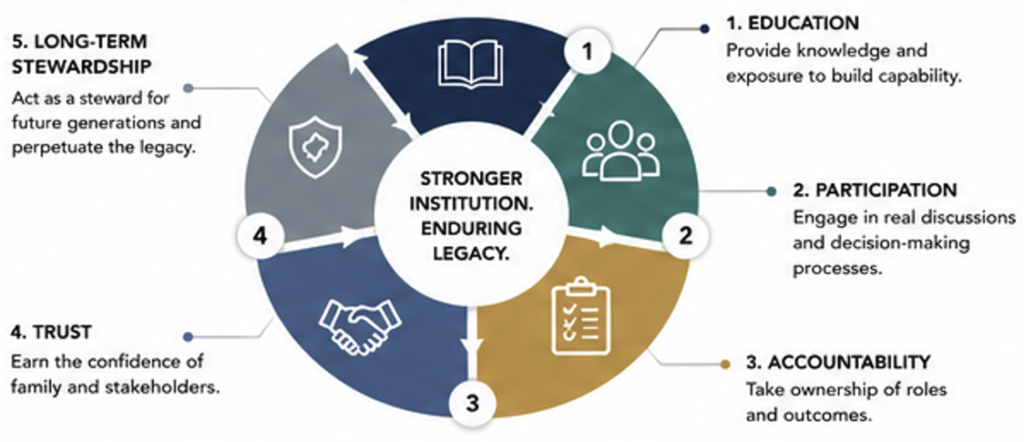
Creating A Stewardship Flywheel
Education is most effective when it is embedded into the normal rhythm of the family office rather than delivered as a one-time programme. Participation in investment committee observations, family meetings, philanthropic discussions and governance reviews should be the norm that allows younger family members to see how principles are applied in practice.
The Stewardship Flywheel
Source: FTCP Capital Stewardship Framework
Over time, this creates a self-reinforcing cycle. Education leads to participation, participation leads to accountability, accountability builds trust, and trust strengthens long-term stewardship.
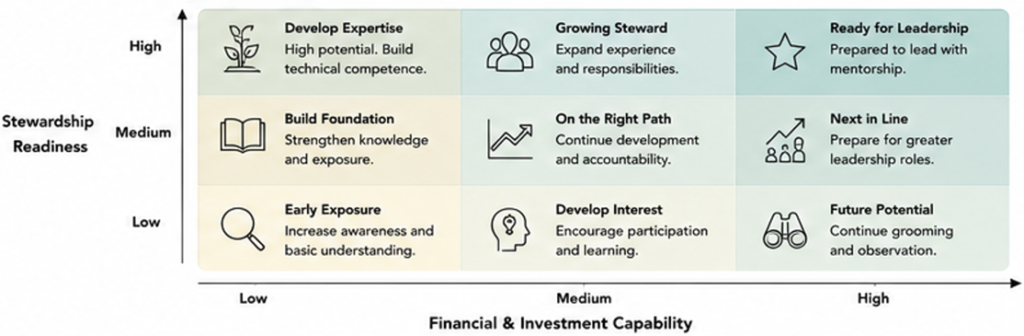
Assessing Generational Readiness
Not every family member will be ready to assume stewardship responsibilities at the same pace. A structured assessment framework can help principals identify where additional education, mentorship or experience is required.
The Generational Readiness Matrix
Source: FTCP Capital Stewardship Framework
The goal is not to exclude family members from the process. It is to ensure that responsibility is matched with demonstrated capability, maturity and commitment.
Key Takeaways
Educating the next generation for stewardship is not an optional exercise for wealthy families. It is one of the most important investments a family office can make in its own longevity.
Families that merely transfer wealth may preserve assets for a time. Families that transfer judgement, values and institutional understanding are more likely to preserve their legacy across generations.
In the end, the measure of successful next-generation education is not whether heirs can discuss financial markets fluently. It is whether they can make thoughtful decisions with humility, discipline and a clear understanding of the purpose behind the capital they have inherited.
#LegacyPlanning #NextGeneration #FamilyLeadership #FamilyOffice #AssetManagement #FTCPInsights