
2026 punished narrative-driven decisions and rewarded structural discipline.Three domains proved this the hard way this year:
- Geopolitics
- Artificial intelligence, and
- Market structure itself
Each produced a moment where the obvious reaction — panic, conviction, or comfort — turned out to be the wrong one. The lesson underneath all three is the same: portfolios built to survive a story tend to break when the story changes. Portfolios and institutionalised decision making designed to survive multi-generations tend not to.
1. Markets Underprice Tail Risk Until It Is Realised, Then Overprice the Resolution
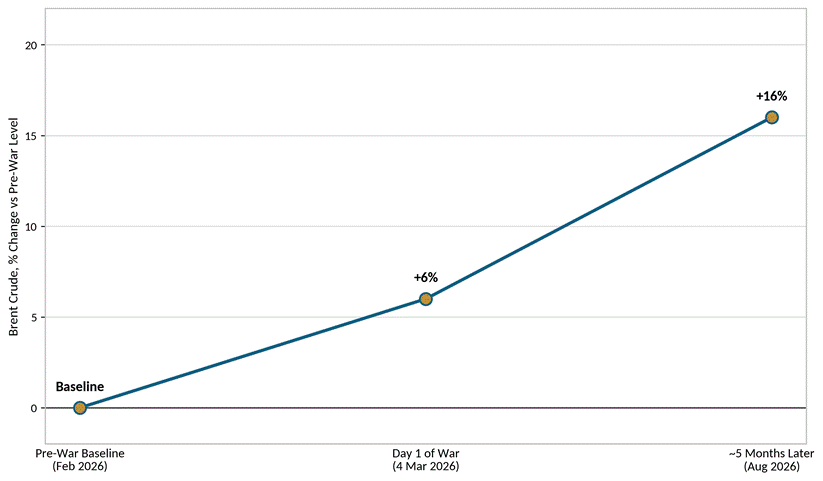
The Strait of Hormuz — the channel carrying roughly one-fifth of the world’s oil supply — was effectively closed within days of the Iran war breaking out in early March. By any historical precedent, that should have been a shock on the scale of 1973. It was not, at least not immediately. Oil rose only about 6 percent on the first day, cushioned by the largest release from strategic reserves on record.
Brent Crude Price Path, 2026: Pre-War, Initial Shock, Persistent Premium
Source: CNBC, Al Jazeera and Fortune reporting on Brent crude price moves, Mar–Aug 2026.
The muted initial reaction was, in hindsight, the wrong signal to take comfort from. The war did not resolve in weeks, as most scenarios assumed. Strait traffic remained disrupted for most of the following five months. By August, Brent was trading roughly 16 percent above its pre-war level — well short of the $200 target some banks had floated in March, but a durable premium rather than a passing spike.
That premium is not an abstraction. It shows up directly in the IMF’s July inflation revision: global headline inflation lifted to 4.7 percent for 2026, with the disinflation trend in place since 2024 now stalled rather than reversed.
The lesson is not that the market mispriced the war. It is that both the initial calm and the initial panic forecasts were wrong, as both assumed the shock would resolve quickly in one direction or the other – not unexpected when decisions are made under pressure.
These are the typical cognitive biasness that family offices need to be aware of, and build systems to guard against.
2. AI Capex Kept Accelerating Through Two Market Flinches — While the Real Risk Built Underneath Them
Twice this year, the market tried to reprice the AI infrastructure trade, and twice it changed its mind within weeks. Chip stocks lost an estimated $1.4 trillion in market value in June on rate concerns, then recovered. They lost more than $1 trillion again in July, this time on doubts that infrastructure spending was “peaking faster than expected,” according to Forrester — and again largely recovered.
Neither selloff addressed the actual structural question. Allianz Research puts the 2026 gap between AI capital expenditure growth and AI-related revenue growth at approximately 46 percentage points — wider than the roughly 32-point gap observed during the 2001 telecom capex bust. Capacity is being built well ahead of monetisation, and the market’s two attempts to price that in this year both resolved as sentiment trades, not structural repricings.
That gap has not closed. It has simply not yet been tested by a demand shortfall large enough to force the issue.
3. Staying Invested Still Paid — With a Caveat Worth Taking Seriously
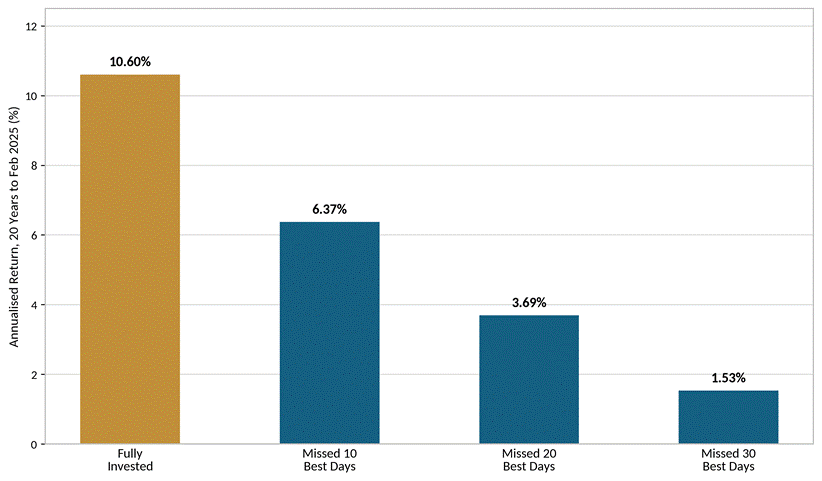
Both of this year’s chip selloffs are an illustration of a broader pattern. Over the twenty years to February 2025, an investor fully invested in the S&P 500 earned a 10.60% annualised return. Missing the ten best days cut that to 6.37%. Missing thirty brought it to 1.53% — barely ahead of cash. Seven of the ten best days occurred within fifteen days of the ten worst.
Missing the Market’s Best Days: 20-Year Annualised Return Impact
Source: J.P. Morgan Asset Management, analysis of S&P 500 Total Return Index using Morningstar Direct data, as of 28 Feb 2025.
The lesson is not “never sell”. Rather, it is that timing the market is extremely challenging, and even most skilled investors and managers have not been able to reliably replicate success consistently.
4. Passive Exposure Quietly Became a Concentrated AI Bet
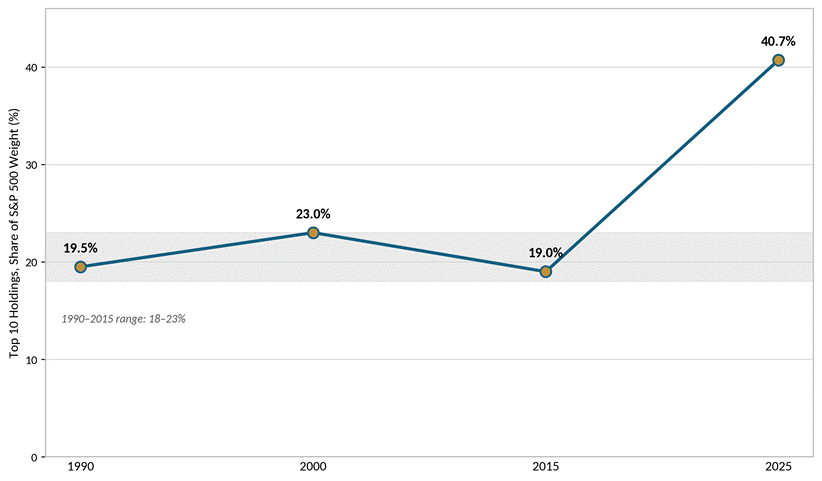
The same capex story shows up in index construction. The top ten S&P 500 holdings held a stable 18–23% of the index’s weight for 25 years through 2015. By the end of 2025, that figure had reached a record 40.7%, driven almost entirely by the same megacap names carrying the capex-monetisation question discussed earlier.
S&P 500 Top 10 Weight Has Nearly Doubled Since 2015
Source: RBC Wealth Management, FactSet, “The Great Narrowing: S&P 500 Concentration,” data as of 31 Dec 2025.
An index investor did not choose this concentration. It accumulated as a side effect of price appreciation in a small number of names — which means the AI monetisation question is no longer a sector bet an index portfolio can opt out of. It is embedded in the default. Family offices aiming for diversification through index investment may hence be taking more concentration risks they are bargaining for.
Key Takeaways
None of this year’s shocks resolved the way the initial reaction assumed. Oil’s muted first-day move was not the end of the story; the AI selloffs were not structural repricings; and the case for staying invested is stronger with the caveat attached than without it. The common thread is a market that keeps reacting to headlines faster than it reacts to mechanisms.
The task for 2027 is not predicting which mechanism breaks first. It is building a portfolio that does not depend on getting that prediction right.
#MarketOutlook #ThoughtLeadership #InvestmentInsights #Geopolitics #ArtificialIntelligence #FamilyOffice #FTCPInsights