

Most family office portfolios are not deliberately designed. Instead, capital is deployed and accumulated over time into a mix of public markets, private investments, credit strategies, and opportunistic deals.
Each decision may be rational on its own at that point in time, but the overall portfolio that is resulted often lacks a unifying structure and intention.
This leads to a common outcome: portfolios that appear diversified are in fact inefficient.
They take more risk than necessary for the returns they generate—or deliver lower returns than they could for the level of risk assumed.
This is precisely the problem that the concept of the efficient frontier seeks to address.
Understanding the Efficient Frontier
At its core, the efficient frontier represents the set of portfolios that provide:
- The highest expected return for a given level of risk, OR
- The lowest possible risk for a given level of return
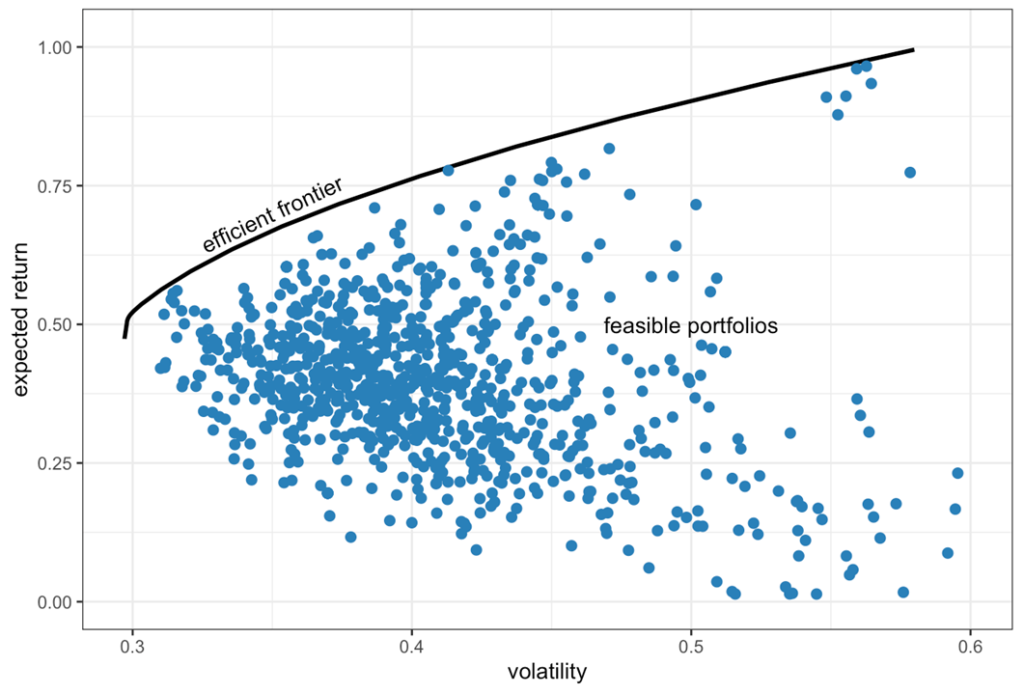
Efficient Frontier: Trade-Off Between Expected Return And Volatility In Portfolios
Source: Portfolio Optimization – Theory and Application, Daniel P Palomar, 1 May 2025
As seen in the exhibit, there are many possible permutations in assets allocation, resulting in many different portfolios. Each combination of assets is a trade-off between expected return and volatility.
Of the many permutations, there is a combination that results in the optimal in terms of risk vs volatility, ie the Efficient Frontier. Any portfolio that lies below this frontier is, by definition, suboptimal.
Portfolios that are below this fronter hence are either:
- Overexposed to risk without sufficient compensation, OR
- Under-allocated to return-generating assets
While the concept is widely understood in theory, it is rarely applied rigorously in practice within family offices.
Why Most Portfolios Fall Short
There are several structural reasons why portfolios drift away from efficiency:
1. Incremental decision-making
Investments are added over time based on opportunities, relationships, or market conditions — rather constructed with intention for overall portfolio impact.
2. Misunderstanding of correlations
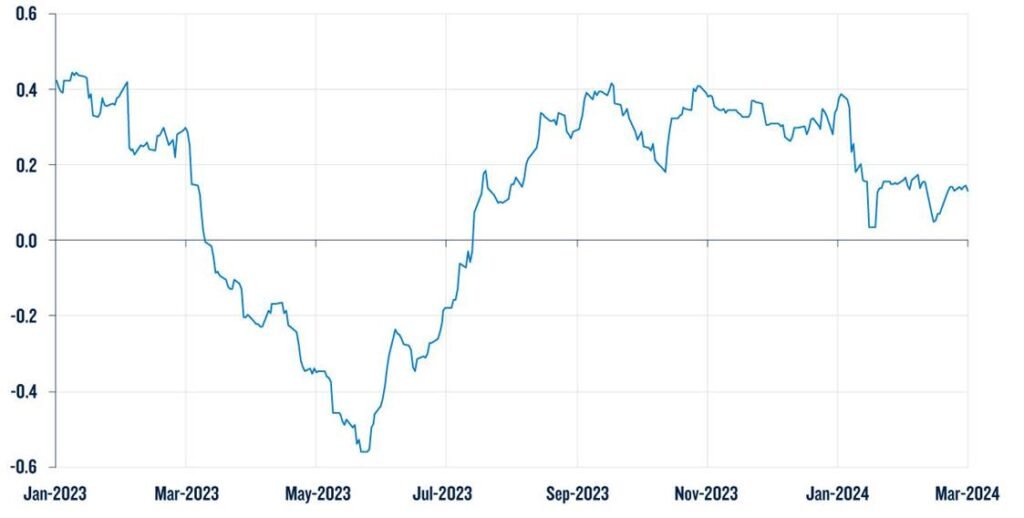
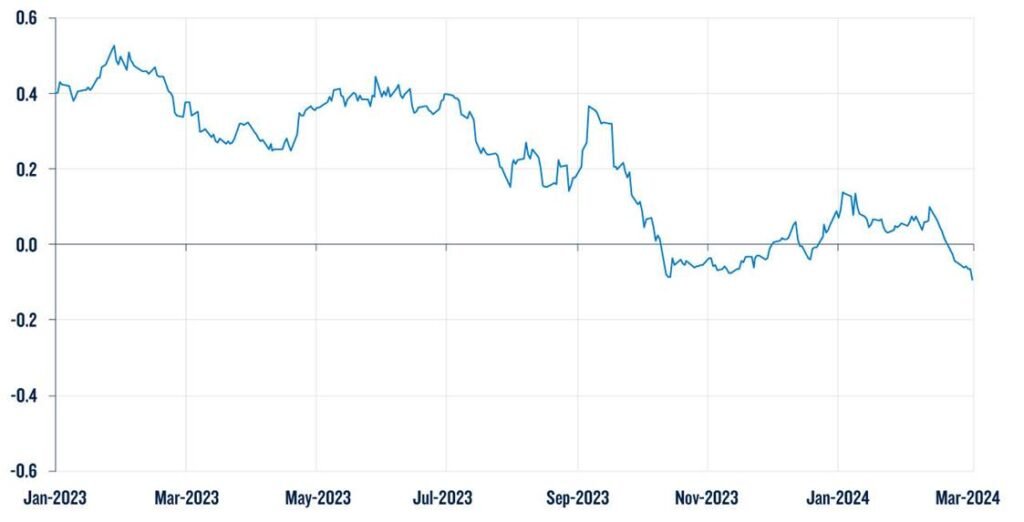
Assets that appear diversified in stable environments may become highly correlated during different market conditions.
As shown in the exhibit, in just within a year, the rolling correlation between equity and bonds fluctuate from positive to negative and back to positive again.
Equity / Bond Rolling Correlations
Source: Cross-Asset Correlations in Market Turbulence, PGIM, 11 Apr 2024
Likewise, this changing correlation is also observed for the equity and commodity rolling correlations during the same short period.
Equity / Commodity Rolling Correlations
Source: Cross-Asset Correlations in Market Turbulence, PGIM, 11 Apr 2024
3. Incomplete risk measurement
Volatility is commonly used as a proxy for risk, but it fails to capture:
- Drawdown risk
- Liquidity risk
- Tail risk
4. Lack of portfolio-level optimisation
Decisions are made at the individual investment level, without sufficient focus on how each component interacts with the rest of the portfolio.
The Institutional Approach
Institutional investors approach portfolio construction with a more structured framework by first defining clear objectives:
- Target real return (e.g. inflation + 4–5%)
- Acceptable volatility and drawdown levels
- Liquidity requirements
Subsequently, the analysis – greatly enhanced through technological advancement – of the different assets and their permutations:
- Estimate expected returns across asset classes
- Analyse correlations, particularly in stressed environments
- Model thousands of portfolio combinations
- Identify portfolios that maximise return per unit of risk
This process produces a set of efficient portfolios—but selecting among them requires further judgement.
Beyond Theory: Real-World Constraints
A purely optimised portfolio is not necessarily implementable or even practical. Family offices must consider additional constraints:
- Liquidity: Private markets may improve expected returns, but excessive illiquidity can create operational challenges, especially when there are cash and liquidity requirements
- Governance: Highly complex portfolios may be difficult to oversee effectively.
- Transparency: Understanding underlying exposures becomes harder as complexity increases, rendering risk management and budgeting difficult.
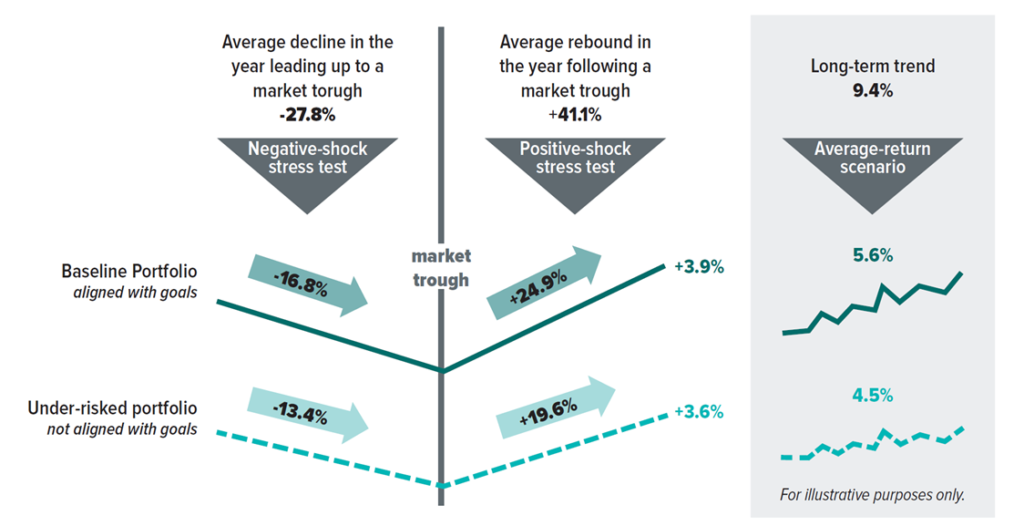
- Behavioural tolerance: Even well-designed portfolios can fail if they cannot be held through periods of drawdown. As observed in the exhibit, emotional selling during downturns can incur permanent losses compared to if they are held to achieve long-term overall gain – the very purpose that they are designed for.
Stress Test Results
Source: SEI Investments Company – No Pain No Gain: Disciplined Investing Through Anxious Times, Mar 2020. Data from Bloomberg, SEI from 1957 to 2019.
These factors mean that the mathematically “optimal” portfolio is not always the right portfolio in practice.
From Efficient Frontier to Robust Portfolio
Therefore, the objective is not necessarily to sit exactly on the theoretical frontier. It is to construct a portfolio that is:
- Close to efficient
- Robust across different market regimes
- Aligned with long-term objectives
- Able to meet liquidity requirements
- Simple enough to be implemented and maintained
In many cases, this leads to family office portfolios that sacrifice a small degree of theoretical efficiency in exchange for significantly greater resilience and durability for long-term wealth stewardship.
Why This Matters More Today
In the current environment:
- Expected returns are lower across most asset classes
- Correlations are less stable
- Prolonged inflation risks
- Tail risks are more pronounced
As a result, inefficiencies in portfolio construction are more costly.
A 1–2% annual drag from suboptimal allocation can compound into a significant shortfall over time. More importantly, poorly constructed portfolios are more vulnerable to large drawdowns, which can permanently impair capital.
Key Takeaway
The efficient frontier is not just a mathematical construct. It is an essential tool in the framework for disciplined decision-making.
For family offices managing multi-generational wealth, the key question is not: “What should we invest in?”
But rather: “How do all our investments work together to achieve our objectives — under both normal and stressed conditions?”
Long-term performance is not determined by individual investments – It is determined by how the portfolio is constructed as a whole.
#EfficientFrontier #PortfolioConstruction #Assetmanagement #FamilyOffice #FTCPInsights