

For twenty years, portfolio construction has rested on a simple assumption: developed markets set the pace, and emerging markets follow it with a lag. That assumption is now backwards.
Three forces are rewriting the map for long-term allocators: a bifurcating growth cycle, a structural reallocation of capital from public to private markets, and an artificial intelligence capital expenditure cycle large enough to move returns across every asset class — whether or not a portfolio holds a single technology stock.
A Two-Speed World, Not a Slowing One
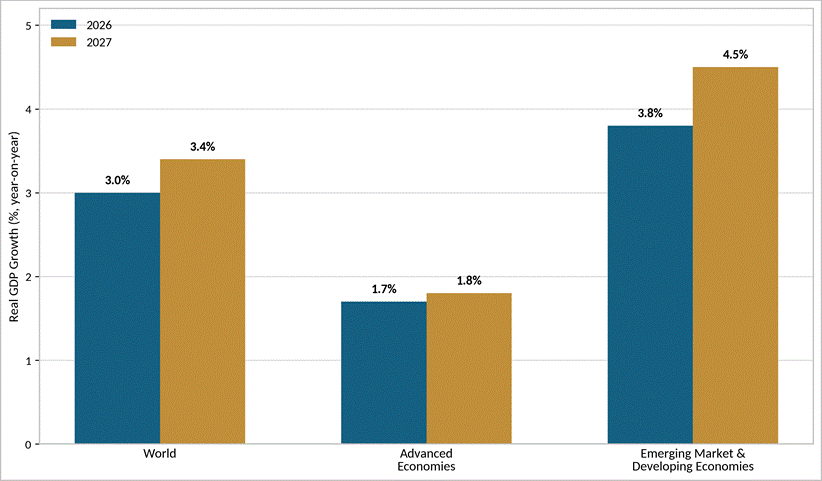
The IMF’s July 2026 update puts global growth at 3.0% this year and 3.4% in 2027 — a modest step down from the 3.5% average of 2024–25. The headline number hides the real story:
- Advanced economies: 1.7–1.8%, weighed down by energy-price sensitivity and, in parts of Europe, direct exposure to the war in the Middle East
- Emerging and developing economies: 3.8% this year, rising to 4.5% in 2027
A Two-Speed Global Recovery: Real GDP Growth, 2026–2027
Source: IMF, World Economic Outlook Update, July 2026.
That is no longer a cyclical gap. It is a structural one.
A portfolio still anchored to developed-market benchmarks is, by construction, underweight where the growth actually is. This is not a cyclical footnote, rather a structural argument for treating emerging and Asian growth as a strategic allocation rather than a satellite position.
The dispersion is technological as much as geographic. Economies plugged into the AI-driven technology cycle are outperforming energy importers with limited participation in that value chain, regardless of income level. Technology exposure, not geography or development status, is becoming the more useful
The Great Reallocation Is Structural, Not Cyclical
Capital is leaving the fund structures that defined the last two decades.
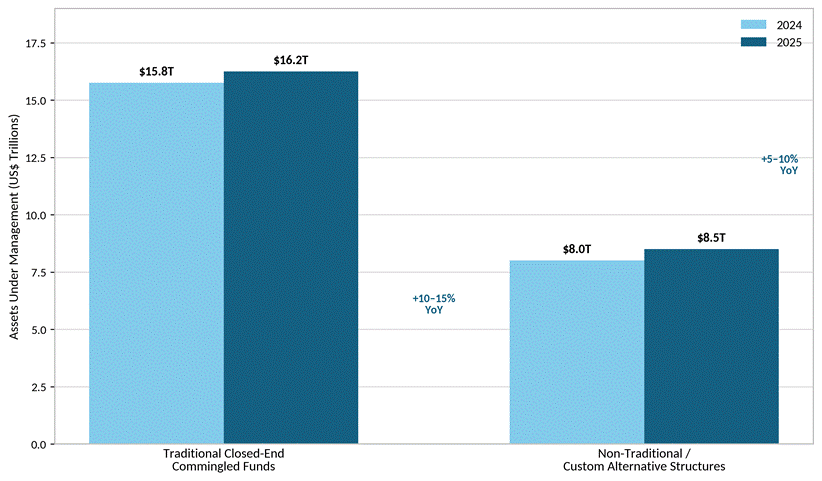
Non-traditional private structures, including private accounts and side deals, grew an estimated 10 to 15% in 2025 to roughly $8.5 trillion, according to the McKinsey’s Global Private Markets Report 2026. This materially outpaces the 5 to 10% growth in traditional closed-end commingled funds, which reached approximately $16 trillion. Global private equity deal value also rose 19% to an estimated $2.6 trillion.
This is not a market simply recovering. It is limited partners demanding more direct control over structure, fees and co-investment rights than a standard commingled fund allows.
Private Capital Outgrows Traditional Structures
Source: McKinsey & Company, Global Private Markets Report 2026, Feb 2026. Figures are approximate, per McKinsey’s disclosed ranges.
The data comes with a warning attached, not just a tailwind:
- More than half of buyout-backed companies globally have now been held for over four years — the highest proportion on record
- Distributions relative to AUM have fallen to roughly 6%, well below pre-2020 norms
The reallocation toward private capital is real. Liquidity discipline, not enthusiasm, is now the binding constraint on how much of it any single-family office balance sheet can prudently absorb.
The Unresolved Question Behind the AI Theme
Every portfolio has AI exposure now. However, few can say where in the value chain it actually sits.
McKinsey projects data centre capital expenditure will exceed $1.7 trillion by 2030, with hyperscalers alone committing more than $400 billion to new capacity. At the same time, the IMF has flagged a possible correction in technology-related expectations as a genuine downside risk to its global forecast.
The important question is not whether AI adoption will continue – it almost certainly will – rather, whether capital deployed into infrastructure, chips and data centres can possibly yield returns that justifies the spending, ie if capacity is being financed too far ahead of demand. This distinction is essential because technological progress and investment returns are not synonymous. The internet transformed the global economy, yet many companies associated with the early internet boom failed to generate durable shareholder returns.
AI can be equally transformative while producing a more difficult investment environment than the narrative suggests. Investors therefore need to distinguish between the economic value created by the technology and the share of that value captured by hardware suppliers, infrastructure owners, software companies, application providers and ultimately the users of AI. The most attractive opportunities may not necessarily sit with the most visible companies; they may emerge where AI changes the economics of an existing business without being fully reflected in competitive dynamics or valuation.
What This Means for Portfolio Construction
None of this argues for abandoning discipline. It argues for updating the defaults.
- Treat Asia and other high-growth economies as a core allocation, not a tactical overweight
- Size private market exposure to genuine liquidity capacity, not to the pace at which capital is being raised
- Spread AI-related exposure across the value chain — infrastructure, semiconductors, hyperscalers, application layer — rather than through a single dominant position
The instruments and geographic assumptions that served portfolios well in the last cycle are not automatically the ones best suited to the next one.
Key Takeaways
The global investment landscape is not simply slowing; it is bifurcating along lines of technology exposure and market structure. Capital is migrating from traditional commingled funds toward customised private structures faster than the underlying liquidity of those structures is improving, which argues for discipline rather than enthusiasm. The artificial intelligence capital expenditure cycle remains the single largest swing factor for returns across asset classes, irrespective of whether a portfolio holds direct technology exposure.
For family offices managing capital across generations, the task is not to predict which force resolves first, but to build a portfolio resilient enough to remain intact whichever way they do.
#GlobalMarkets #InvestmentOutlook #AssetAllocation #PrivateMarkets #FamilyOffice #AssetManagement #FTCPInsights