

Emerging markets is a top 2026 performer, holding up during the recent conflict. Its importance is clear, and it plays an important role in institutional portfolio.
Year-To-Date Performance Vs Performance Since The US-Iran Conflict, Total Return %
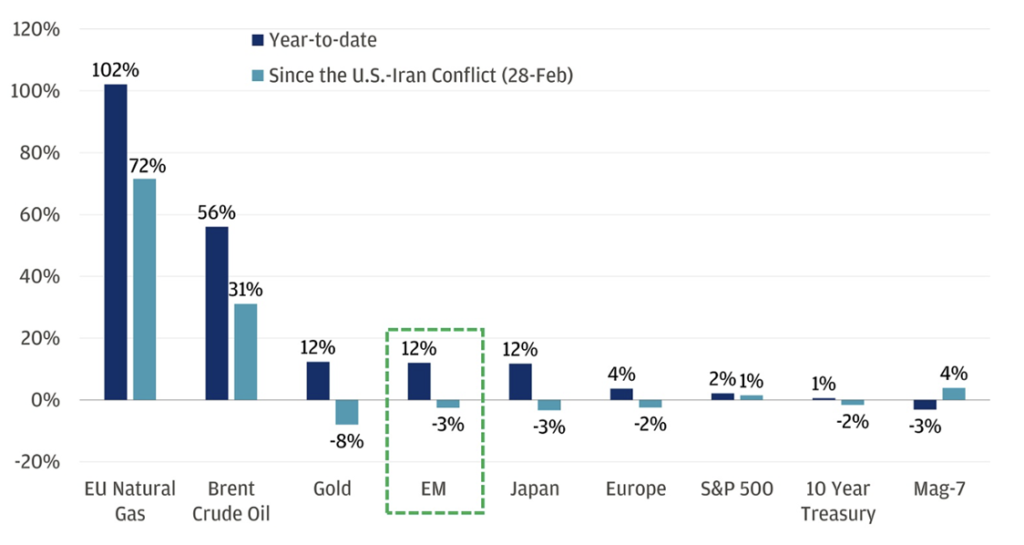
Source: Emerging markets may offer more than meets the eye. Selectivity matters, 17 Apr 2026. JP Morgan Private Bank
However, for many years, emerging markets occupied a relatively straightforward role. Investors allocated a percentage of capital to an emerging market fund, embraced the benefits of portfolio diversification, expected higher long-term growth than developed markets, and accepted the associated volatility and uncertainties.
The framework was simple, widely adopted and, for a time, reasonably effective.
Today, however, the traditional emerging market allocation model is becoming increasingly obsolete – for the simple fact that emerging markets are no longer a homogeneous asset class.
Instead, they represent a highly diverse collection of economies with dramatically different growth drivers, political systems, demographic trends and investment opportunities.
For family offices and institutional investors, this evolution requires a fundamental rethink of how emerging market exposure should be constructed.
The Origins of Emerging Market Investing
The concept of “emerging markets” became popular during the late twentieth century when many developing economies began opening their financial markets to international capital.
At the time, grouping these countries together made practical sense since many shared similar characteristics:
- Rapid economic growth
- Developing financial systems
- Lower per-capita income levels
- Higher political and economic risks
Investors were compensated for these risks through the potential for higher returns.
As globalisation accelerated, emerging markets gradually became a standard component of institutional portfolios.
Emerging Markets Are No Longer Homogeneous
Today’s emerging markets are not homogeneous and can in fact be substantially different from one another.
Different emerging markets can have vastly different policies, and hence outcomes when dealing with external shocks. In fact, several large emerging markets offer among the highest real policy rates in view of the recent war and associated inflationary pressures.
Policy Rates Minus Trailing Headline Inflation, %
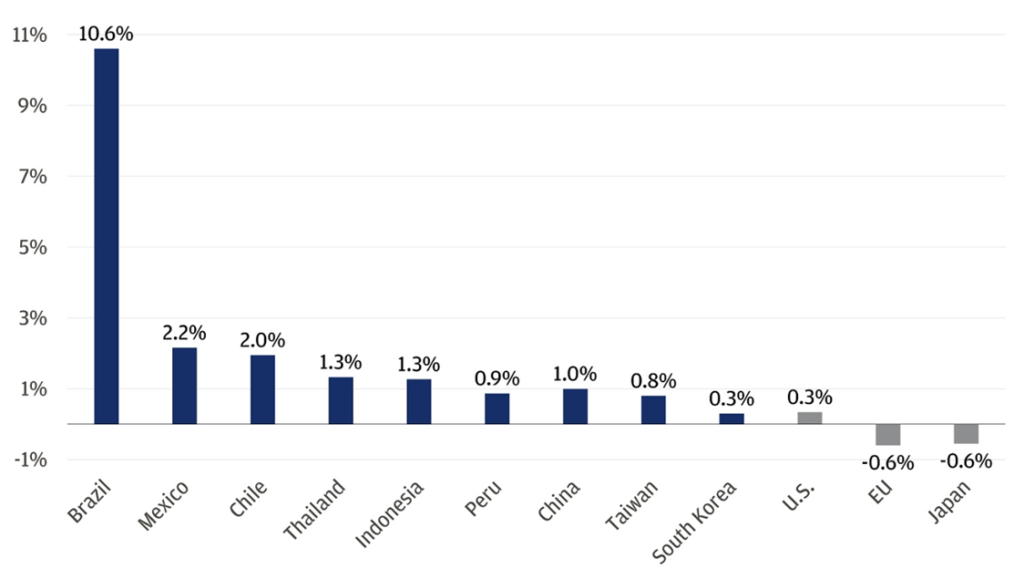
Source: Bloomberg Finance L.P. Data as of April 15, 2026. Emerging markets may offer more than meets the eye. Selectivity matters, 17 Apr 2026. JP Morgan Private Bank
It is naïve to simply collectively group them as a single asset class. Consider these few examples as an illustration:
1. China
China is one of the world’s second largest economies and a major force in manufacturing, technology and global trade. However, investors increasingly face questions surrounding:
- Demographics
- Property markets
- Geopolitical tensions
- Regulatory intervention
China’s investment case today is very different from the emerging market status that it had twenty years ago.
2. India
India presents a contrasting story. The country benefits from:
- A young population
- Rapid digitalisation
- Growing domestic consumption
- Expanding manufacturing capabilities
Many investors view India as one of the most important long-term growth opportunities globally.
3. Southeast Asia
Countries such as Indonesia, Vietnam and the Philippines are benefiting from:
- Urbanisation
- Supply-chain diversification
- Rising incomes
- Favourable demographics
These economies are attracting both foreign investment and manufacturing capacity, as well as China + 1 optionality. However, even within Southeast Asia alone, political uncertainties may at times impact investors’ sentiments, as seen recently in Indonesia in the market upheaval and talks of potential downgrades.
4. The Middle East
Several Gulf economies are actively diversifying away from hydrocarbon dependence through large-scale investment initiatives. The region is becoming increasingly relevant in infrastructure, technology and renewable energy investments.
At the same time, geopolitical tensions and the Iran war have casted doubts on previously viewed “safe havens” such as Dubai. These realities are real and need to be considered clearly, rather than grouped together with the same assumed risks.
5. Latin America
Latin America remains heavily influenced by commodity cycles but also offers opportunities linked to agriculture, natural resources and domestic economic reform.
Each of these regions presents distinct opportunities and risks. Treating them as a single investment category increasingly makes little sense.
The Problem With Traditional Benchmarks
Many emerging market indices are heavily concentrated. In some cases, a small number of countries dominate overall index composition.
As a result, investors may believe they are gaining diversified emerging market exposure when they are taking in fact concentrated positions in only a handful of markets.
This concentration can distort portfolio outcomes and create unintended risks.
Benchmark-driven investing may therefore fail to capture the full diversity of opportunities available across emerging economies.
A Better Framework: Investing in Structural Themes
Institutional investors are increasingly shifting from geography-based allocations towards theme-based allocations. Rather than investing in “emerging markets” broadly, they seek exposure to specific structural trends.
Examples include:
1. Consumer Growth: Rising incomes and expanding middle classes across Asia and other regions continue to drive demand for goods and services.
2. Digitalisation: Emerging economies often leapfrog legacy infrastructure and adopt new technologies rapidly.
3. Manufacturing Diversification: Companies are increasingly diversifying supply chains beyond traditional manufacturing hubs, especially given geopolitical uncertainties.
4. Infrastructure Development: Urbanisation and economic growth require ongoing investment in transportation, energy and digital infrastructure.
5. Financial Inclusion: Millions of consumers continue to gain access to banking, insurance and investment services.
These themes may offer more targeted exposure than broad market indices, that may be unnecessarily overweighted.
Implications for Family Offices
For family offices managing multi-generational wealth, emerging markets remain an important source of long-term growth. However, success and returns should not be assumed, and increasingly depends on selectivity.
The key question is no longer: “Should we invest in emerging markets?”. That is a given.
Instead, investors should ask:
- Which countries possess the strongest long-term fundamentals?
- Which structural themes are likely to create value?
- How do emerging market exposures complement the overall portfolio?
- What are the structural risks and uncertainties for each country?
This shift reflects a broader evolution in portfolio construction as simplistic allocation models become less effective.
Key Takeaways
Emerging markets are not disappearing as an investment category. However, they are becoming too diverse and layered to be treated as a single asset class.
Family offices need to move beyond broad labels and develop a deeper understanding of the underlying economic drivers, risks and geopolitical uncertainties shaping each market. This means replacing traditional allocation frameworks with more selective, thematic and forward-looking approaches.
The future of emerging market investing will not be about owning everything.
It will be about knowing precisely what you own—and why.
#EmergingMarkets #AssetAllocation #GlobalInvesting #FamilyOffice #FTCPInsights