
Investing in the Age of Artificial Intelligence and Data
Over the past decade, the investment industry has experienced one of the most profound technological transformations in its history. Advances in artificial intelligence, machine learning, and data analytics are reshaping how investors research markets, construct portfolios, and manage risk.
Yet despite these technological breakthroughs, the fundamental challenge of investing remains unchanged: allocating capital under uncertainty.
Understanding how technology can impact investing requires looking beyond the headlines.
The Data Revolution in Finance
Financial markets generate enormous amounts of data. Traditional datasets include:
- Company financial statements
- Macroeconomic indicators
- Interest rates and bond yields
- Equity prices and trading volumes
In recent years, investors have begun to incorporate entirely new categories of information known as alternative data. These include:
- Satellite imagery (to track consumers and industrial activities)
- Credit card transaction data
- Web traffic analytics
- shipping and logistics data
- Social media activities and sentiment
By analysing these data, investors hope to gain additional insights and observe even real-time economic activities (compared to delayed traditional data) to better assess corporate performance and market trends.
However, collecting data is only the first step. The real challenge lies in extracting meaningful signals from vast amounts of information.
Artificial Intelligence and Pattern Recognition
Artificial intelligence (AI) excels at identifying patterns in large datasets.
Machine learning models can analyse thousands of variables simultaneously, searching for relationships that may not be obvious to human analysts. In investment research, AI is commonly used for:
- Analysing earnings call transcripts
- Detecting sentiment in news articles
- Identifying anomalies in trading patterns
- Forecasting short-term market behaviour
These tools dramatically expand the analytical capabilities of investment teams.
However, AI models also face important limitations. They rely heavily on historical data, which they are trained on. To achieve good predictive performance, it is always tempting to overfit a model based on past data. However, that increases errors in real-world performance.
Real-World Predictive Errors Increase With Performance On Training Data
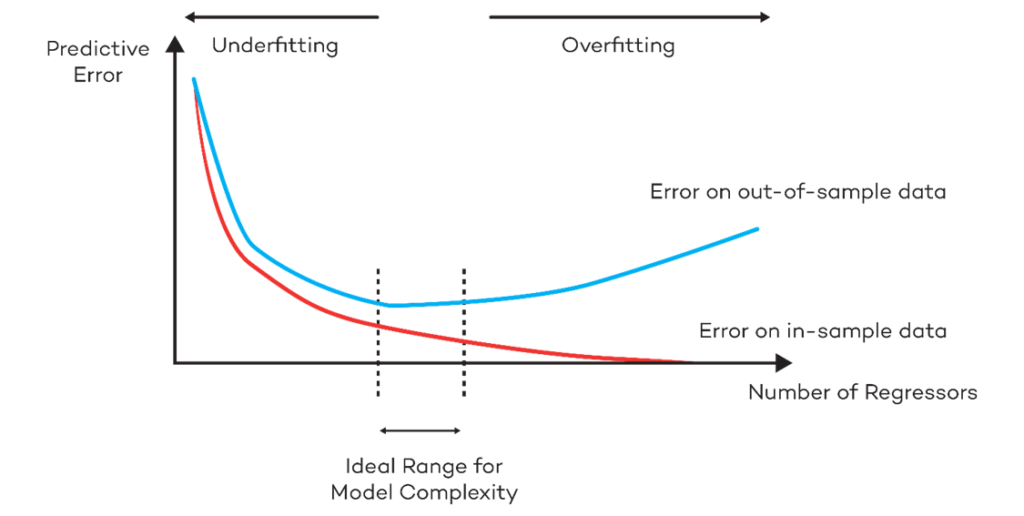
Source: Overfitting: What it is and how to avoid it? AlternativeSoft, Jul 2021
Besides the dangers of underfitting and overfitting, the reality is that when market conditions change or unprecedented events occur, models trained on past patterns may also fail.
This limitation was evident during black swan events such as the Global Financial Crisis, when many risk models underestimated the possibility of extreme market stress.
The Human Element
Despite advances in technology, investing remains deeply influenced by human factors.
Markets reflect the collective behaviour of millions of participants responding to economic incentives, political developments, and psychological pressures.
No algorithm can fully capture these dynamics.
Successful investors therefore need to combine quantitative tools with human judgement.
Technology processes information efficiently, while experienced investors interpret broader economic narratives and structural changes.
Portfolio Construction in the Data Era
Technology is also transforming how portfolios are constructed and monitored.
Advanced analytics allow investors to understand portfolios in terms of risk factors rather than just asset classes.
A volatility-targeted portfolio may appear to target a certain level of risk through diversification across equities, hedge funds, and private investments, but it may still be heavily exposed to the same underlying drivers such as economic growth or liquidity conditions.
Modern risk systems help identify these hidden exposures.
Investors can then construct portfolios that are more resilient across different economic environments.
Technology and Risk Management
Perhaps the greatest contribution of technology is improved risk management.
Using AI in Risk Management and Compliance in Portfolio Management
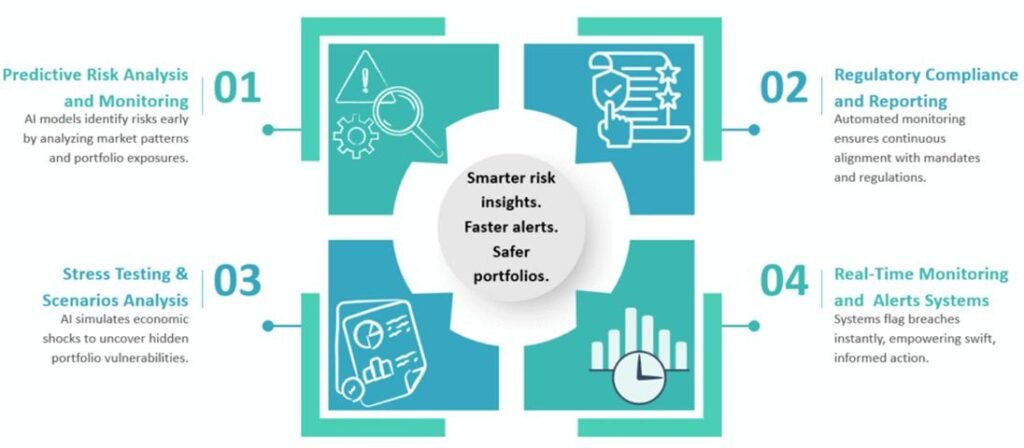
Source: AI in Portfolio Management: Growth and Key Trends. Magistral Consulting, 17 June 2025
Sophisticated platforms allow investors to perform:
- Scenario analysis
- Stress testing
- Correlation analysis
- Liquidity monitoring
These tools help investors anticipate how portfolios might behave during extreme market events.
Risk management will never eliminate losses, but it significantly improves the ability to manage uncertainty responsibly.
The Competitive Landscape
As technology becomes more widespread, its comparative advantage gradually diminishes. What was once a cutting-edge capability eventually becomes an industry standard.
Today, many investment firms have access to similar data sources and analytical tools that were considered niche and unique only to the most advanced institutional investors.
This means that eventually the real differentiator is not technology itself, but how effectively organisations integrate technology into their decision-making processes.
The Enduring Importance of Strategy
Even in a world of advanced algorithms and massive datasets, the most important investment decisions remain strategic.
Investors must still determine:
- How much risk to take
- How to allocate capital across asset classes
- How to manage liquidity
- How to maintain discipline during market volatility
These decisions require judgement, experience, and governance structures that support long-term thinking.
Technology can inform these decisions, but it cannot and should not make them automatically.
The Future of Investing
Looking ahead, technology will continue to reshape the investment landscape. Artificial intelligence will continue to evolve and become more powerful. Data sources will become richer. Analytical tools will become more sophisticated.
However, the fundamental principles of successful investing will remain remarkably consistent:
- Disciplined portfolio construction
- Thoughtful risk management
- Long-term investment horizons
- Strong governance frameworks
Technology changes the tools available to investors – it does not change the underlying logic of capital allocation.
Key takeaway
In the age of artificial intelligence, the greatest advantage will not belong to those with the most data, but to those who combine technology with sound judgement, disciplined processes, and long-term thinking.
#Fintech #AI #InvestmentTechnology #FamilyOffice #AssetManagement #QuantFinance #AIFinance #FTCPInsights