
For much of modern financial history, investing and purpose were often treated as separate pursuits. Capital was expected to maximise returns, while philanthropy was expected to address social objectives.
Today, that distinction is becoming less clear.
Across the world, family offices, foundations, endowments and long-term asset owners are increasingly exploring the concept of mission-aligned capital.
The idea is not new. What is different is the scale and sophistication with which it is being implemented.
Mission-aligned investing seeks to achieve two objectives simultaneously:
- Generate attractive risk-adjusted financial returns
- Support outcomes that reflect the values, priorities or long-term vision of the capital owner
This trend is particularly visible among multi-generational family offices.
Mission-aligned Discipline
As wealth transitions to younger generations, many families are asking broader questions about the role of capital in society:
- How can investments support innovation?
- How can capital contribute to healthcare, education or sustainability?
- How can a family’s financial resources reflect its long-term legacy?
However, successful mission alignment requires strict investment discipline.
One of the most common mistakes is allowing purpose or emotions to replace investment analysis. That naturally can only lead to disappointment.
Institutional investors understand that mission-aligned investing is still essentially investing and not speculation. Capital still needs to be allocated efficiently. Risks still need to be assessed. Returns still need to justify the underlying risk exposure.
The strongest mission-aligned portfolios are built upon clear frameworks.
They typically define:
- Financial return objectives
- Risk tolerances
- Liquidity requirements
- Desired impact outcomes
- Measurement and reporting standards
This creates accountability and prevents mission drift.
Index performance of select MSCI ESG Indexes and MSCI All Country World Index
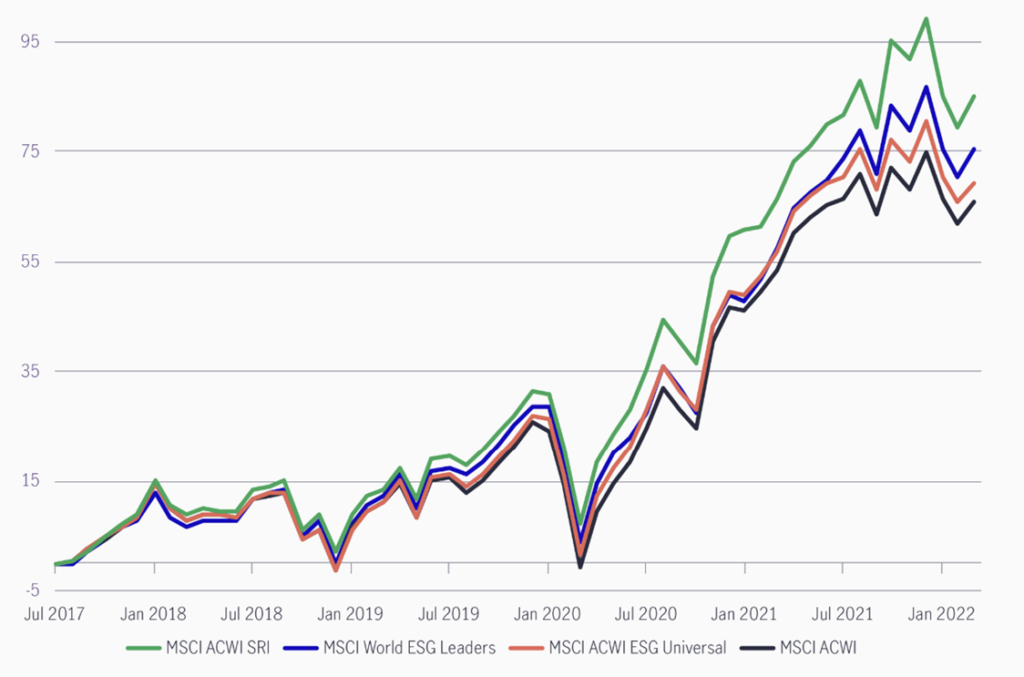
Source: Bloomberg data for 31 July 2017 – 31 March 2022
Mission alignment does not mean sacrificing returns. As shown in the chart above, the different MSCI ESG indexes outperform the MSCI All Country World Index (ACWI) index.
Many opportunities naturally sit at the intersection of commercial success and societal benefit. Healthcare innovation, renewable infrastructure, educational technology and productivity-enhancing technologies are examples where financial and societal objectives can often coexist.
Key Takeaway
For family offices, mission alignment should not be viewed as a trend.
It is a strategic exercise in defining the purpose of capital as wealth is more than a financial asset – It is a resource that shapes businesses, communities and future generations.
The most enduring families often recognise that long-term stewardship involves not only preserving capital, but also directing it intentionally with the family values.
#MissionAlignedCapital #Stewardship #FamilyOffice #AssetManagement #LegacyPlanning #FTCPInsights