
Over the past decade, few topics in investing have generated as much debate as ESG.
Supporters have argued that environmental, social and governance considerations are essential for responsible investing. Critics have dismissed ESG as marketing, political signalling or a distraction from financial returns.
Yet beneath the headlines and debates, something important has happened.
Many of the world’s leading pension funds, sovereign wealth funds, endowments and family offices have quietly changed how they think about ESG. Increasingly, they no longer view ESG as a separate investment strategy.
Instead, they view it as part of a broader framework for understanding long-term risk and value creation – this is a significant evolution.
Transition Towards Fundamentals
The first generation of ESG investors often focused on exclusions and ratings. Investors screened out certain sectors or selected companies with high ESG scores.
Today, institutional investors are asking a more sophisticated question: How do environmental, social and governance factors influence future cash flows, competitive positioning and long-term resilience?
This shift moves the discussion away from labels and towards fundamentals.
Broad ESG Considerations
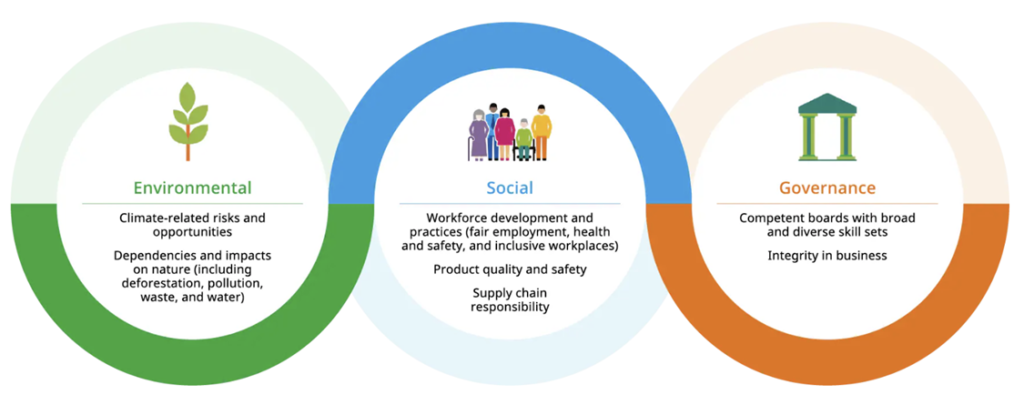
Source: Embedding ESG as Part of Our Investment Process, Temasek Investment Company
Governance, Environment and Social
Few investors would dispute that governance quality matters. Poor governance has been responsible for some of the largest corporate failures in history. Weak board oversight, misaligned incentives and poor capital allocation decisions can destroy decades of shareholder value.
Environmental and social factors can also be viewed through a similar lens.
On the practical front, these governance, environmental and social factors can have a real impact on businesses.
A manufacturing company facing increasing regulatory scrutiny may encounter higher compliance costs. Likewise, businesses dependent on vulnerable supply chains may experience operational disruptions due to environmental changes. Social issues can too impact how a company attract the relevant talent to maintain competitive advantage.
These are not merely ESG issues. They are in fact investment issues.
Rethinking ESG Rating
Institutional investors are also becoming more selective about how ESG information is used.
A high ESG rating need not automatically make an investment attractive. Similarly, a company facing ESG-related challenges may still represent an attractive opportunity if those risks are understood and adequately reflected in valuation.
Key Takeaway
As ESG continues to evolve, the most successful investors will likely be those who focus less on scores and labels, and more on understanding how sustainability-related factors affect long-term investment outcomes.
Because ultimately, investing is not about narratives. Families set up systems to identify risks and opportunities before they become obvious to everyone else.
#Sustainability #ESG #Stewardship #FamilyOffice #AssetManagement #FTCPInsights