
The world’s family offices are no longer waiting to see how this decade turns out. They are already repositioning for it.
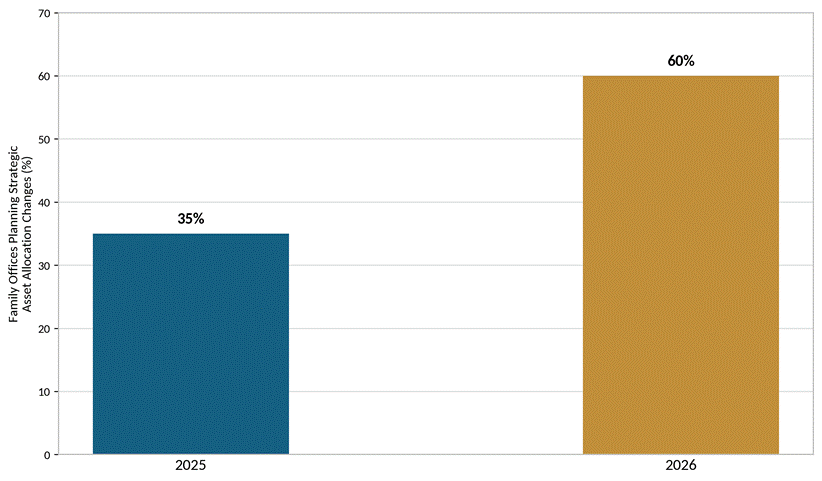
UBS’s Global Family Office Report 2026 surveyed 307 family offices worldwide, average net worth $2.7 billion. 60% now plan to change their strategic asset allocation in the next 12 months — up from 35% a year earlier, the highest proportion UBS has recorded since it began tracking the question. This is not a narrative about panic. 64% cite major geopolitical conflict as a top concern for the next year, 61% over five years, with little expectation the risk recedes on its own.
Family Offices Planning Strategic Asset Allocation Changes, 2025 vs 2026
Source: UBS, Global Family Office Report 2026, surveying 307 family offices, Jan–Mar 2026.
1. The Dollar Doubt Is No Longer a Contrarian View
65% of family offices surveyed expect confidence in the US dollar’s reserve status to weaken, and many are reassessing USD-denominated exposure directly. These are demonstrated through adoption multi-currency frameworks, with the euro and Swiss franc emerging as the preferred alternatives.
This is no longer a fringe view arriving from outside the industry. It is the median position of the world’s largest private capital pools. This is consistent with the discussion on the erosion of USD reserve-share and credit-rating discussed in Megatrends.
One notable exception: US-domiciled family offices have moved in the opposite direction, raising North American allocation from 86% to 88% even as global peers diversified away. This home bias intensifying at the exact moment the underlying currency risk is rising is worth highlighting. Intentional or not, the US family offices are increasing their concentration risks, and it deserves to be evaluated as one.
2. Capital Is Leaving Real Estate and Flowing Toward Infrastructure
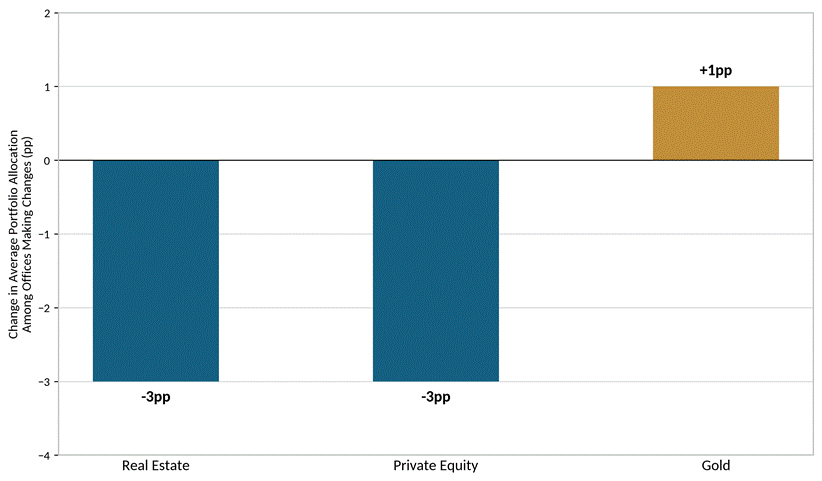
Real estate allocations are expected to fall from 11% to 8% among family offices making active changes. This capital is shifting toward infrastructure, including infrastructure especially artificial intelligence related.
Read together, these numbers indicate that family offices are increasingly buying the picks and shovels — power generation, grid capacity, security infrastructure — not simply the software layer on top. That is the same conclusion reached from the supply side, in the IEA’s data on data centre electricity demand. It is useful to see it confirmed from the demand side, in where actual family capital is now flowing.
3. Private Equity Is Losing Its Default Status
Private equity allocations are trending down, from roughly 21% to 18% in portfolios among those making changes. The freed capital is seen rotating into private credit, hedge funds, and secondaries — structures offering shorter duration and more predictable distributions than a 10-year fund lockup. This is not a retreat from private markets broadly: alternatives still make up 42% of the average portfolio, and private markets 29%, both remaining roughly stable. It is a rotation within private markets towards liquidity, echoing the distribution-versus-AUM concern.
The 2026 Rotation: Change in Average Allocation Among Family Offices Making Changes
Source: UBS, Global Family Office Report 2026.
4. Gold Is No Longer a Rounding Error
The average gold allocation is expected to rise from 2% to 3%. While a modest number in isolation, it is directionally consistent with the central bank gold-buying trend covered previously, and a meaningful shift for an asset family offices have historically treated as immaterial.
What This Means Going Into 2027
None of these shifts is a family office acting alone on a hunch. Each is a specific, measurable response to a specific, measurable risk — currency, power, liquidity, and monetary confidence. Each lines up with the structural data behind it, not just sentiment.
The honest reading is not that family offices have discovered something new. It is that the megatrends are now visible enough that the market’s largest, most sophisticated private capital pools have started pricing them in unison.
The coming decade will not reward the family offices that saw these shifts first. Most of the largest ones already have. It will reward the ones that positioned for them with the most discipline.
#FamilyOffice #WealthManagement #AssetAllocation #PortfolioStrategy #FTCPInsights