
Historically, global investors have largely operated within a framework shaped by developed markets.
The United States served as the world’s innovation engine. Europe represented a major economic bloc. Most institutional asset allocation models were built around developed-market assumptions regarding growth, demographics and capital formation.
That framework is gradually changing.
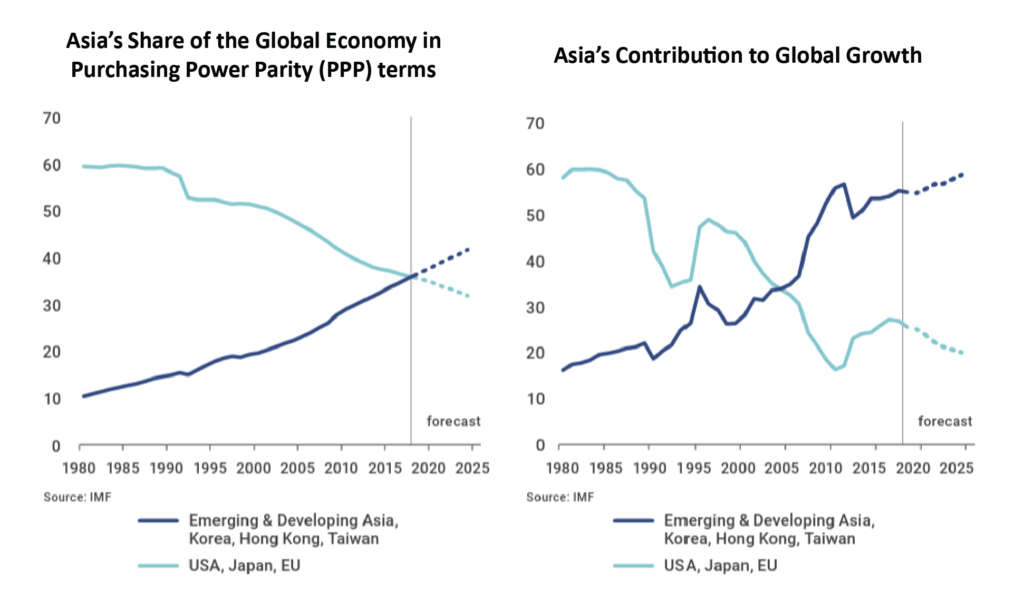
Source: GIC Report on the Management of the Government’s Portfolio for Year 2018/19.
The rise of Asia is no longer simply an economic story. It is increasingly a capital markets story.
For family offices, pension funds and institutional investors, understanding Asia’s growing role may become one of the most important strategic considerations of the coming decades.
The Shift in Global Economic Gravity
For much of modern history, economic power has shifted gradually between regions. Today, we are witnessing another such transition.
Asia now contributes a significant portion of global GDP growth and contains many of the world’s fastest-growing economies.
Consumer Class Spending (% of Global Total)
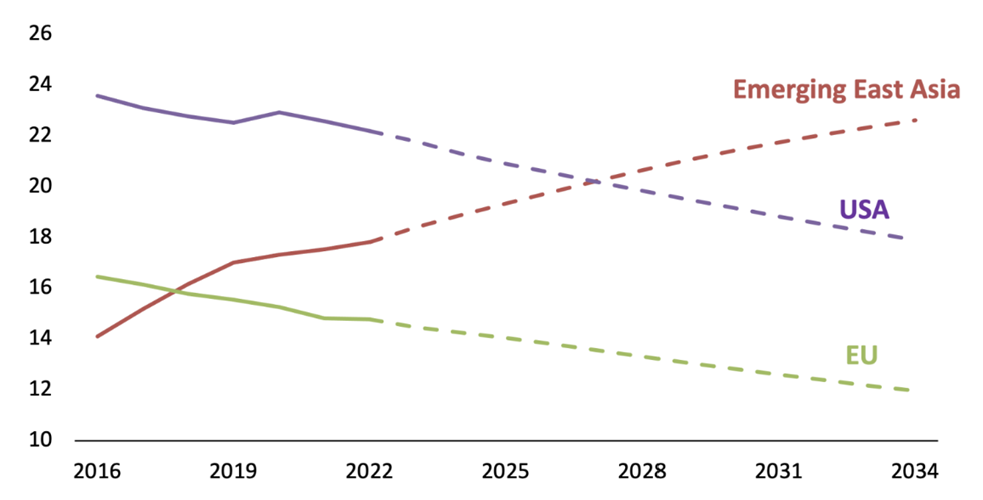
Source: Asia’s Trade at a Turning Point, Brookings, Sebastian Eckardt, Jun Ge, Hassan Zaman, 20 Mar 2023
Overall consumer spending in emerging East Asia economies is expected to continue to grow and overtake USA, and become a major driver of the global economy.
The region benefits from:
- Large and growing consumer populations
- Expanding middle classes
- Increasing urbanisation
- Rising productivity
- Rapid technological adoption
Unlike previous decades, growth is no longer concentrated solely in China.
India, Indonesia, Vietnam and other Southeast Asian economies are becoming increasingly important contributors to regional growth. This diversification strengthens the overall investment case for Asia.
Asia’s Wealth Creation Engine
Perhaps even more important than GDP growth is the pace of wealth creation. Across Asia, entrepreneurs are creating businesses at unprecedented rates.
Technology, manufacturing, healthcare, financial services and consumer sectors continue to generate new fortunes and investment opportunities.
This has led to a significant increase in:
- Family offices
- Private investment companies
- Venture capital firms
- Private equity funds
Singapore has emerged as one of the leading beneficiaries of this trend. The city-state has become a preferred jurisdiction for many Asian and global families seeking political stability, regulatory clarity and sophisticated financial infrastructure.
With increasing geopolitical uncertainties between USA and China, Singapore has become a much trusted and neutral platform for dialogue and testing ground for collaboration.
Beyond China
For many years, investing in Asia effectively meant investing in China. That is no longer the case.
China remains a critical component of the global economy, particularly in manufacturing, technology and industrial capacity.
However, investors increasingly recognise that Asia’s opportunity set extends far beyond a single country.
India offers:
- Favourable demographics
- Expanding digital infrastructure
- Rapid domestic consumption growth
Southeast Asia offers:
- Young populations
- Manufacturing expansion
- Supply-chain diversification
Countries such as Indonesia, Vietnam and the Philippines may benefit from long-term structural shifts as global companies seek alternatives to concentrated production networks.
The Rise of Asian Capital
Historically, capital largely flowed from developed markets into emerging economies.
Today, capital increasingly flows within Asia and from Asia into global markets. Asian family offices, sovereign wealth funds and institutional investors are becoming major allocators of global capital.
Asia-Pacific Share Sales Closed
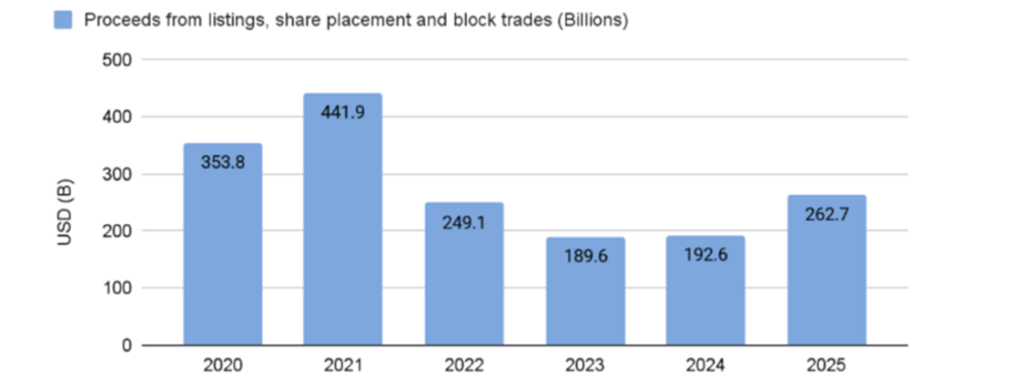
Source: Asia’s Growing Role in Global Capital Markets, FTCP Insights, 22 Jan 2026
This has profound implications.
Investment trends are increasingly being influenced not only by New York and London, but also by Singapore, Hong Kong, Tokyo, Mumbai and other regional centres.
Opportunities for Family Offices
For long-term investors, Asia presents opportunities across multiple asset classes:
- Public Equities: Growing companies and expanding domestic markets.
- Private Equity: Entrepreneurial ecosystems and family-owned businesses.
- Infrastructure: Transport, logistics, digital infrastructure and energy transition projects.
- Private Credit: Rapidly expanding financing needs across the region.
- Real Assets: Industrial property, logistics and urban development opportunities.
Importantly, many of these opportunities are driven by structural growth rather than short-term market cycles.
Risks Cannot Be Ignored
The investment case for Asia is compelling but not without challenges. Investors must consider:
- Geopolitical tensions
- Regulatory uncertainty
- Governance standards
- Currency volatility
- Political risk
These risks vary significantly across countries, and reinforces the importance of selective and disciplined investing.
Implications for Portfolio Construction
The traditional approach of allocating a small percentage of capital to “Asia” may become increasingly inadequate.
Institutional investors are beginning to recognise that Asia may warrant dedicated strategic consideration rather than being viewed as a peripheral allocation.
The objective is not necessarily to increase exposure indiscriminately. Rather, it is to ensure portfolios properly reflect the growing role Asia is likely to play in global economic activity.
Key Takeaways
The rise of Asia is not a short-term investment theme. It is a long-term structural shift.
For family offices tasked with preserving and growing wealth across generations, ignoring this transformation may become increasingly difficult, if not impossible.
The question is no longer whether Asia deserves attention. The question is whether portfolios are positioned appropriately for a world in which Asia plays a much larger role than it has in the past.
#AsiaInvesting #GlobalMarkets #FamilyOffice #AssetManagement #LongTermCapital #FTCPInsights