
Why Sustainability Is Risk Management, Not Marketing
The sustainability debate often becomes polarised. One side argues sustainability should be central to every investment decision, while the other argues it has become little more than marketing.
Institutional investors generally approach the issue differently. They ask a simpler question: Does this factor affect long-term investment risk and return?
If the answer is yes, it deserves consideration. If the answer is no, it does not.
When viewed through this lens, sustainability becomes less about ideology and more about investment analysis and risk management.
Evaluating Future Risks And Opportunities
Many sustainability-related issues fit naturally into this framework.
- Poor governance can result in fraud, regulatory penalties or poor capital allocation
- Environmental liabilities can create future costs that are not immediately visible in financial statements
- Labour practices, talent retention and supply-chain resilience can influence long-term competitiveness
These factors may not appear prominently in quarterly earnings reports, but they can materially affect future cash flows.
Mapping Sustainability Risks Into Risk Management Frameworks
Not every issue will be relevant to every company or industry. The challenge is determining which sustainability factors are genuinely material to which industry, and then to map these risks factors accordingly.
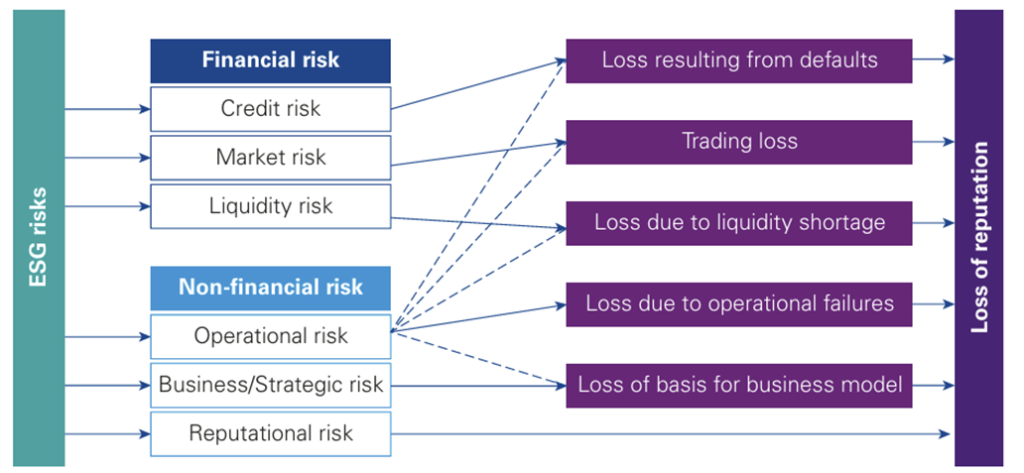
Source: ESG risks in banks, KPMG International, 2021
Institutional investors increasingly integrate these considerations into broader risk-management frameworks rather than treating sustainability as a separate investment category.
Mapping of the ESG risks into risk-management frameworks offers two advantages:
- Helps identify risks that traditional financial analysis may overlook.
- Avoids allowing sustainability considerations to override sound investment discipline.
The goal is not to invest based on slogans. It is to improve understanding of long-term risk-adjusted returns.
For family offices, this distinction matters.
Key Takeaway
The purpose of sustainability analysis is not to signal virtue. It is to ask whether a business, asset or strategy is likely to remain resilient over the next ten, twenty or even fifty years.
Essentially, sustainability is not about marketing. It is about understanding how long-term risks evolve — and how to position portfolios accordingly.
That is precisely what prudent stewardship has always been about.
#RiskManagement #Sustainability #Stewardship #Governance #FamilyOffice #FTCPInsights