

Given recent market environments, generating reliable income has become challenging in portfolio construction. Traditional fixed income no longer provides sufficient real yield, while equity-based income introduces volatility many families cannot tolerate.
Today, many institutional investors — including endowments, pensions, and sophisticated family offices — are increasingly turning to private credit as a core income engine. Private credit has moved well beyond niche strategies. It is now a multi-trillion-dollar asset class providing financing where banks have retreated due to regulation and capital constraints.
Why Private Credit Matters Now
Structural forces are driving its rise:
- Regulatory constraints have reduced bank lending
- Borrowers seek flexible, long-term capital
- Investors demand income with capital protection
Private credit strategies today span:
- Senior direct lending
- Asset-based lending
- Special situations and rescue financing
- Real estate and infrastructure debt
Properly structured, private credit can deliver higher yields with lower volatility than even public high-yield bonds.
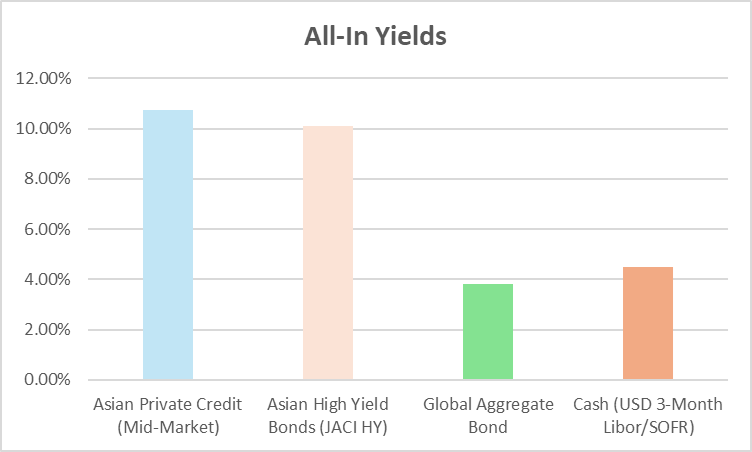
Source: AIMA (Alternative Credit Council) “Private Credit in Asia” Report 2024; Schroders Asian Credit Outlook 2025. Numbers revised for Asian Private Credit to reflect mid-point returns.
Risks Involved
Private credit is not without risks, and investors should assess the corresponding risks involved:
- Lack of transparency, commonly without mark-to-market
- Illiquidity with long lockups
- Interest rate sensitivity with floating rates
- Potential for underwriting failures with looser covenants and payment-in-kind (PIK)
- Inflated valuations
- High borrower leverage leading to increased default risks
- Portfolios become overly concentrated
What Distinguishes Institutional-Grade Private Credit
Institutional investors can mitigate the risks through:
- Senior secured positions
- Strong covenants and collateral
- Diversification across borrowers and vintages
- Manager underwriting discipline, not simply yield chasing
Portfolio Role
Private credit should not be viewed as a return enhancer alone. Its true value lies in:
- Stable income generation
- Lower correlation to public markets
- Capital preservation across cycles
Key Takeaway
For family offices, private credit works well as a strategic allocation, not a tactical trade. Position it as part of the income core — diversified, conservatively structured, and manager-selective.
#PrivateEquity #PrivateCredit #Alternatives #FamilyOffice #AssetManagement #FTCPInsights