
Investors are hungry for yields. Yet, yields from the broad market asset classes, especially fixed income, have been consistently low (< 4%) and steadily declining for the past few decades.
Yields from Broad Market Asset Classes Steadily Declining
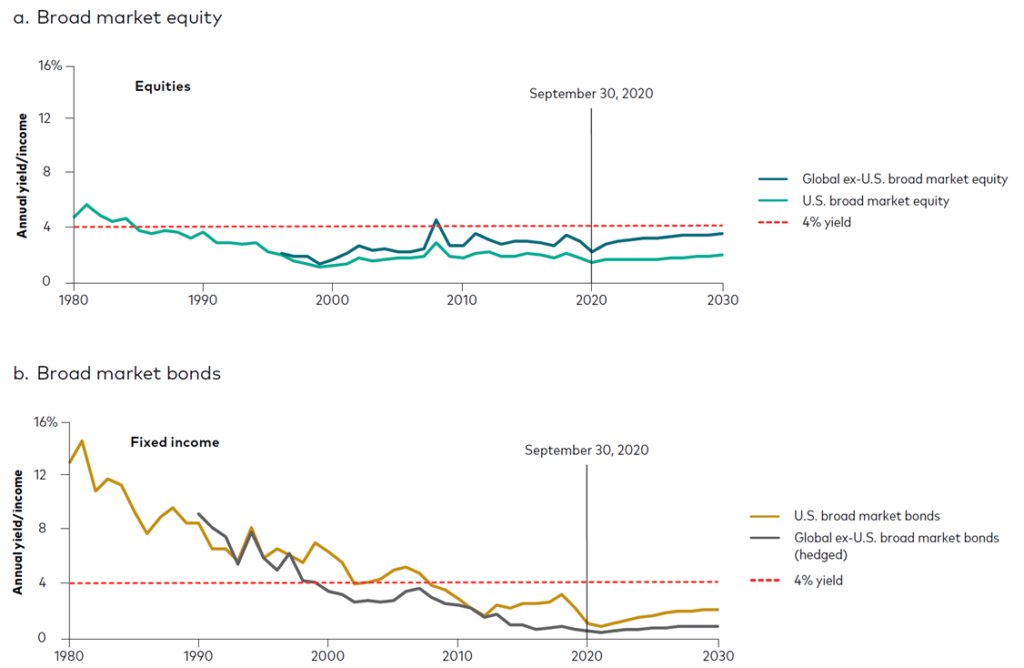
Source: Vanguard Research – A systematic approach to constructing high-income portfolios, Dec 2021. Data are as of 30 Sep 2020.
The challenge sophisticated family offices face is not just generating higher yield or income, but rather, how to do so without embedding hidden risks that may compromise long-term capital.
History shows that most yield-driven underperformance does not come from insufficient income, but from poorly understood risk trade-offs. This may be especially pronounced for investments in private markets and alternatives.
Why Yield Chasing Destroys Long-Term Wealth
High yields are rarely free. They often compensate investors for risks that are hidden, and only materialise during stress:
- Liquidity risk
- Credit deterioration
- Leverage and refinancing risk
- Correlation spikes during drawdowns
The mistake many portfolios make is treating yield as a standalone objective, rather than as one component of a total return and risk-budgeting framework.
Family offices should not ask, “What yields the most?”. This will only distract them from their stewardship of long-term capital preservation and growth.
Instead, family offices need to see yield, risks, and growth in totality in the entire portfolio and ask, “What role does this income play in the portfolio?”
How Institutions Think About Income
In world-class endowments and family offices, income assets are typically categorised into three roles:
1. Capital Preservation Income
Assets designed to protect purchasing power and dampen volatility, including high-quality credit and defensive carry strategies.
2. Contractual Cash Flow Assets
Income backed by legal or structural protections such as seniority, collateral, or regulated cash flows.
This includes select private credit, real estate (such as infrastructure and logistics) debt, and asset-backed lending.
3. Opportunistic Yield
Higher-returning income strategies with cyclical or credit sensitivity, sized carefully and monitored actively.
Importantly, institutions do not rely on any single yield source.
A Framework for Safer Income Construction
A robust income portfolio should be built using the following principles:
- Diversify by risk driver, not by product label
- Avoid embedded leverage, especially where refinancing risk is opaque
- Stress-test income durability, not just headline yield
- Size income strategies within an explicit risk budget
Yield should be treated as a by-product of sound portfolio construction, not the primary objective.
Key Takeaway
The goal is not to maximise yield — it is to engineer reliable cash flow that survives market stress.
The most successful family offices will be those that prioritise income resilience over any short-term gains, aligning yield strategies with long-term capital stewardship.
#Inflation #IncomeInvesting #Volatility #FamilyOffice #AssetManagement #FTCPInsights