

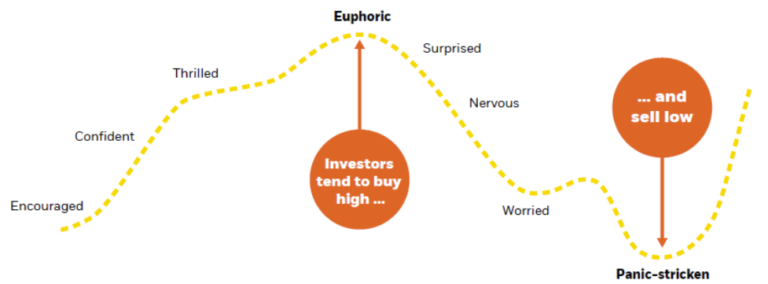
The next decade will redefine what it means to be a successful Single Family Office (SFO). Market cycles are shortening, correlations are rising, exacerbating the negative impact of emotional buying and selling (“behaviour gap”).
Riding the ups and downs of the market
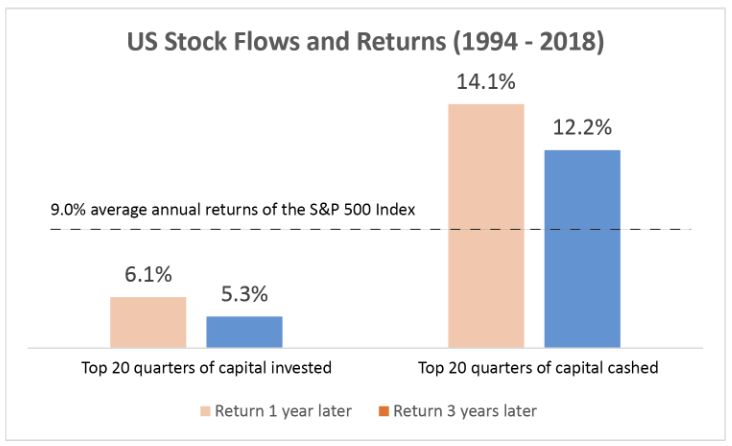
The average investors get the timing wrong, and the impact over 25 years is quite significant. The chart below shows that periods that followed investors cashing out have experienced above-average returns (14.1% one year later), while periods where cash flowed in have experienced below-average returns (6.1% one year later) – a very substantial delta of 800 bps.
As such, to navigate this changing landscape, SFOs must increasingly adopt the discipline, governance, and portfolio construction frameworks used by world-class university endowments.
Below is a practical breakdown of what this shift looks like — and why it matters.
1. A New Reality for SFOs
Families today face:
- Higher market volatility
- Compressed yields
- Increasing global geopolitical risk
- Greater expectations for multi-generational capital preservation
Endowments have spent decades solving these exact challenges. Success cannot depend on luck, nor in timing markets, but in building resilient, rule-based investment processes.
2. What Endowments Do Differently
The largest endowments share three traits that SFOs can adopt immediately:
a. Governance before returns
Clear mandates, disciplined processes, and long-term policies to reduce emotional decision-making — the biggest source of return leakage for families through behaviour gap.
b. Portfolio diversification built on “return engines”
Endowments think in functional buckets:
- Growth (public equities, private equity)
- Stability (bonds, high-grade credit)
- Inflation protection (real assets, commodities)
- Alternatives (hedge funds, absolute return)
SFOs that lack these structures often end up over-exposed to a single risk factor to prevent it from achieving institutional-grade long-term compounding.
c. A long-term, multi-cycle mindset
Endowments are not trying to beat the market only for this year — the aim is to protect purchasing power for the next 50 years.
3. Why This Matters for Family Offices
Families that adopt endowment-style principles have:
- More consistent risk-adjusted returns
- Reduced behavioural mistakes or behaviour gaps during volatility
- Better alignment across generations
- Stronger governance and manager oversight
In a world where uncertainty is the only constant, process and discipline become the most important safeguards to one’s asset.
Key Takeaway
SFOs that evolve into institutional-grade allocators will be the ones that thrive in the coming decade.
This transition is no longer optional — it is a strategic necessity.
#TailRisk #PortfolioResilience #WealthManagement #FamilyOffice #AssetManagement #FTCPInsights